 |
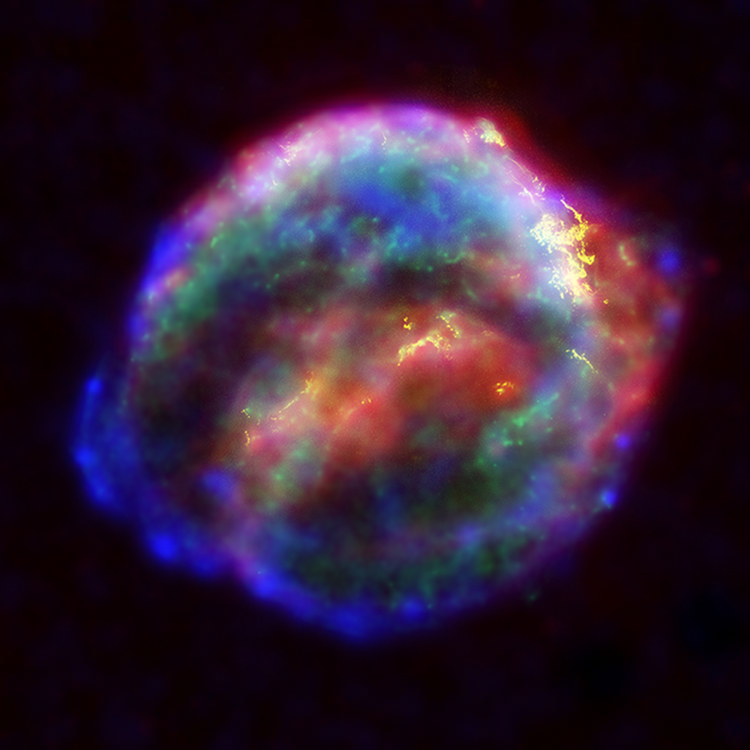
| SN 1604 (Kepler's Supernova) |
First observed on October 9, 1604 in Italy, Kepler's Nova occurred in the Milky Way Galaxy in the constellation Ophiuchus. The supernova occurred about 20,000 light-years from Earth, and had a peak magnitude of about -2.5. It has a 17h 40m 42s right ascension, and −21° 29′ declination. This remnant type is known as Ia meaning it is from the violent explosion of a white dwarf.
 |
| W49B |
Located 35,000 light-years from Earth, W49B is a barrel shaped believed to be the remnant of a gamma-ray burst. A gamma ray burst is produced when a massive star runs out of nuclear fuel and the star's core collapses to form a black hole surrounded by a disk of extremely hot, rapidly rotating, magnetized gas. Much of this gas is pulled into the black hole, but some is flung away in oppositely directed jets of gas traveling at near the speed of light, leaving the image you see above. The image was taken with the Chandra X-ray telescope. The burst is believed to have occurred about 1,000 years ago. It's located at 19h 11m 09s right ascension and +09° 06' 24 declination.
 |
| Veil Nebula |
Located in the constellation Cygnus at 20h 45m 38.0s right ascension and +30° 42′ 30″
declination, the Veil Nebula is about 1,470 light-years away. It has an apparent magnitude of 7.0 and has an apparent diameter of 3 degrees in the sky. The source supernova is believed to have exploded about 5,000 to 8,000 years ago.It was discovered by William Herschel on September 5, 1784.


No comments:
Post a Comment