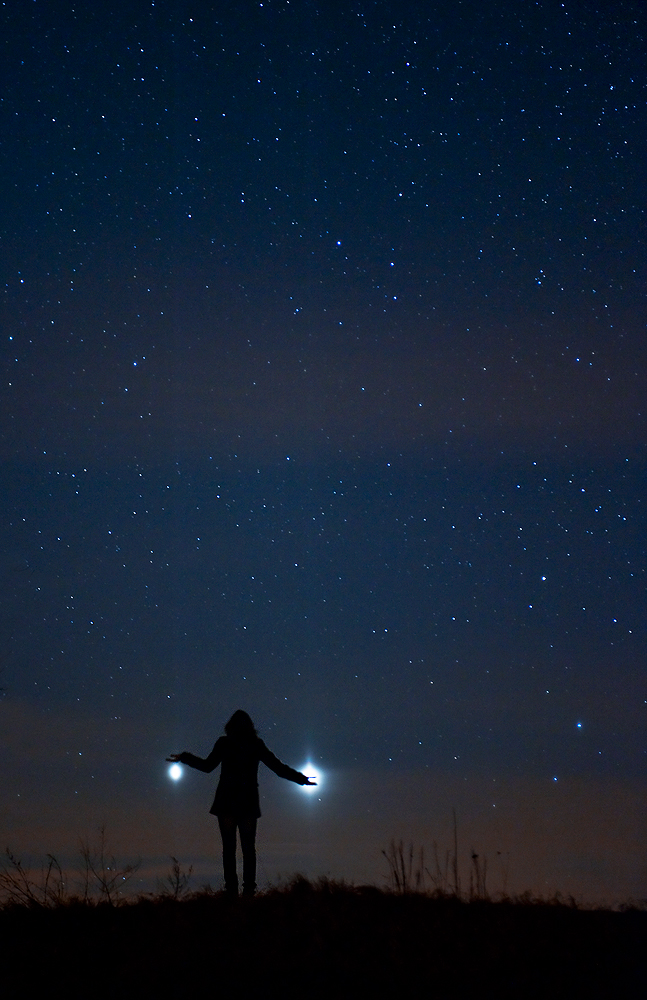
 |
| Jupiter and Venus from Earth (March 18, 2012) |
Thursday, March 29, 2012
APOD 4.1

Wednesday, March 28, 2012
Astronomy Cast 3.1: Schrodinger’s Cat (Episode 249)
Schrodinger’s Cat's is an illustration in quantum theory of superposition describing that we can never truly know what is happening to something or what it's doing if we can't see it. The experiment was done by Erwin Schrödinger in 1935. The basic set up of the experiment is a living cat is placed in a steel chamber along with device containing a vial of a very small about of hydrocyanic acid (which is a radioactive substance). Once the substance starts to decay, it triggers a mechanism that breaks the vial, releasing the acid, which would kill the cat. Because the container is enclosed and the observer cannot see inside, they are unaware if the substance has started to decay, and if the cat is dead. Since there is no way of knowing without opening the box, the cat is considered to be dead and alive in what is known as a superposition of states. It is concluded that because the outcome is determined my the observation, the outcome does not exist unless the observation is made.
APOD 3.8
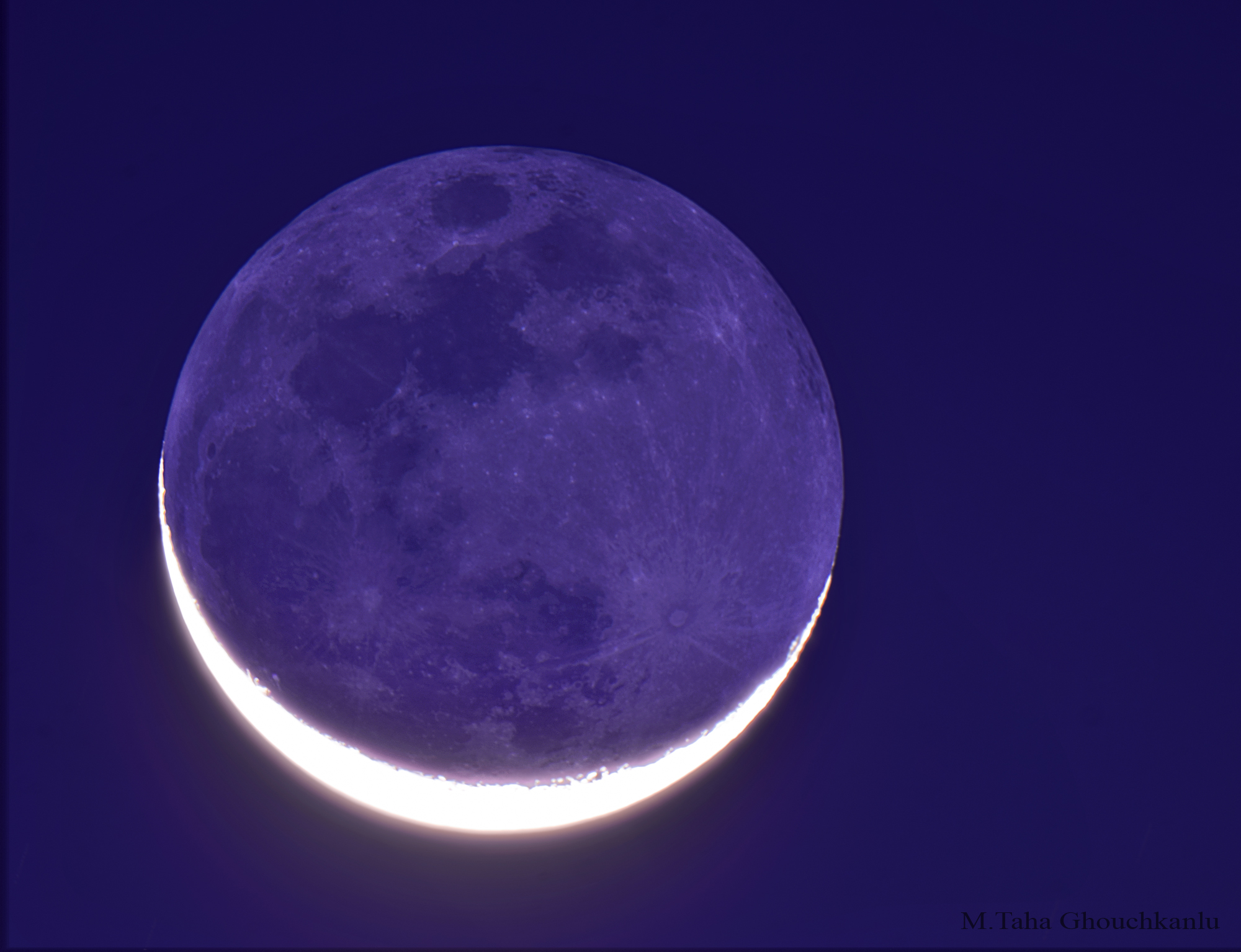 |
| The New Moon in the Old Moon's Arms (March 24, 2012) |
Wednesday, March 21, 2012
Supernova Remnants
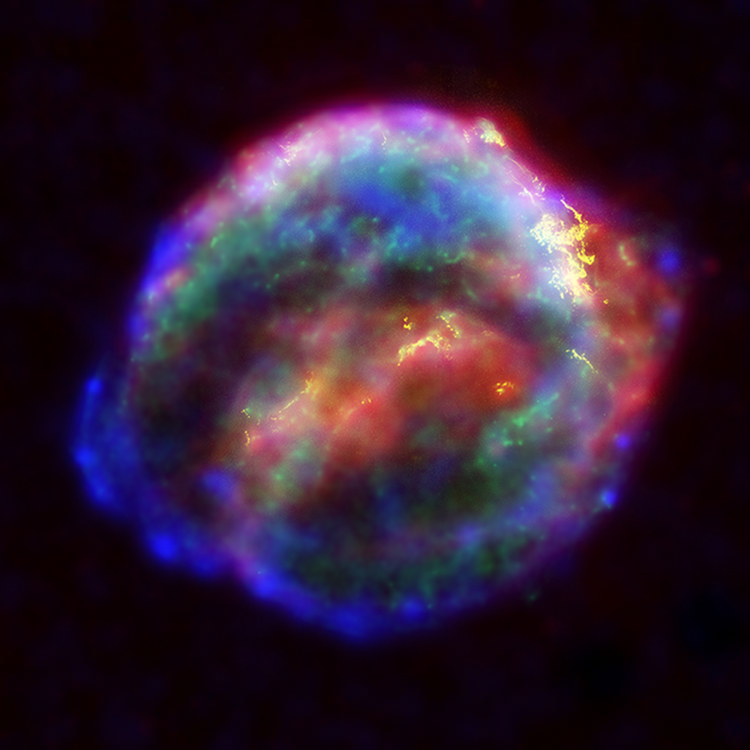 |
| SN 1604 (Kepler's Supernova) |
 |
| W49B |
 |
| Veil Nebula |
Friday, March 9, 2012
APOD 3.7
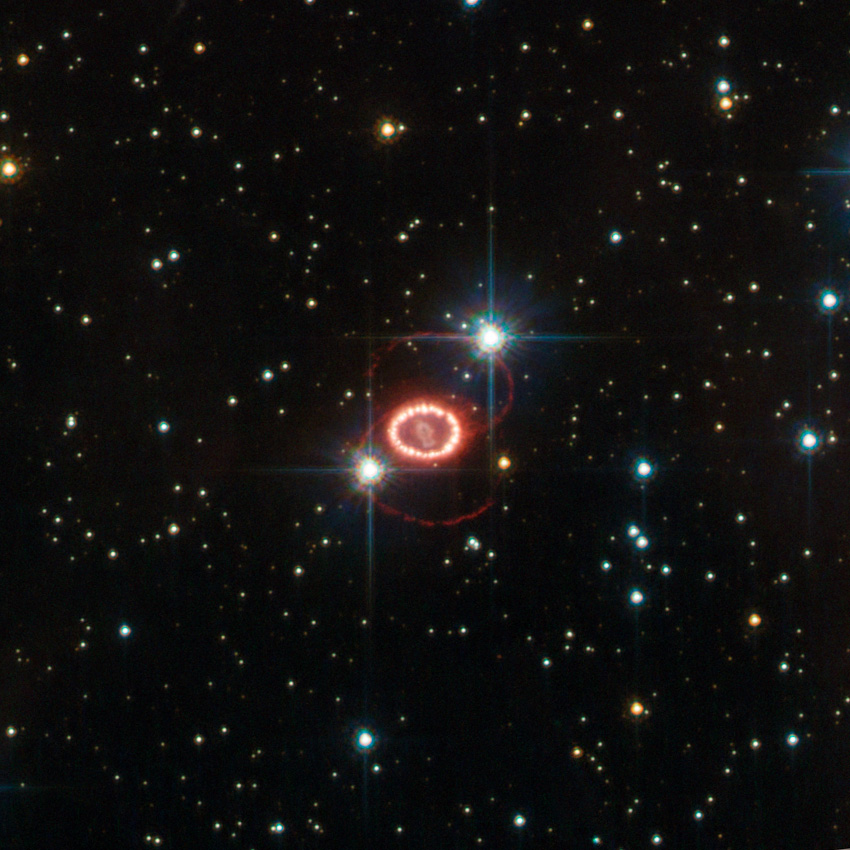 |
| The Mysterious Rings of Supernova 1987A (February 26, 2012) |
Friday, March 2, 2012
Q3 Astronomer Biography: Edward Emerson Bernard

Edward Emerson Bernard was an American astronomer and astronomical photographer born on December 16, 1857, in Nashville, Tennessee. Bernard was schooled by his mother until he was nine, and then was employed for 16 years for a photographer in Nashville where he was trained in photographic processing. This training and his knowledge of photographic lenses became useful in his career as an astronomer.
Bernard became interested in astronomy in 1876 after reading a book about astronomy and building his first telescope out of a broken spyglass. He continued working as a photographer's assistant while studying astronomy at night.
On May 12, 1881, Barnard discovered his first comet, which however he did not announce. He found his second comet on September 17 of the same year, and another one on September 13, 1882. After these discoveries, he was accepted to Vanderbilt University and graduated in 1887 with a bachelor's in science. He was then appointed junior astronomer at the recently established Lick Observatory, which had a new 36-inch telescope. This was the largest telescope in the world, at the time. In 1892, Bernard discovered Jupiter's fifth moon, Amalthea. He later discovered the sixth, seventh, eighth, and ninth moons of Jupiter as well. Bernard also started to photograph the Milky Way Galaxy, capturing the intricate designs which he became famous for.
In 1895, Bernard accepted a position at the Yerkes Observatory, and started observing using the 40-inch photographic telescope in 1897. Barnard next began the micrometric triangulation of some of the globular clusters, which he continued for nearly 25 years, hoping to detect motions of the individual stars.
In 1916 he discovered the proper motion of the 9.5 magnitude star cataloged as Munich 15040 or LFT 1385 located in the constellation Ophiuchus. This star later became known as Bernard's Star. In his lifetime, Edward Emerson Bernard collected 1400 negatives of comets, nearly 4000 plates of the Milky Way and other star fields, published more than 900 papers, had the honor having a Mars crater, moon crater, asteroid, and residence hall at Vanderbilt University after him. he died on February 6, 1923 at the age of 66.
APOD 3.6
 |
| A Sailing Stone in Death Valley (February 22, 2012) |
Subscribe to:
Comments (Atom)