Friday, May 25, 2012
Zooniverse
While working on it, I participated in classifying galaxies, detecting solar storms, and detecting merging galaxies. I also did the activity where I identified craters on the Moon. Sometimes working on one activity for a long time became monotonous, so I would jump around from day to day.

Thursday, May 24, 2012
Astronomy Cast 4.2: String Theory, Time Travel, White Holes, Warp Speed, Multiple Dimensions, and Before the Big Bang (Episode 31)
This podcast discusses some theoretical concepts that people constantly ask about:
String Theory - According to string theory, our Universe is composed of more than three spacial dimensions and time, and that at the subatomic level, what we’re seeing is just one aspect of a particle that is a string if you’re able to see it in the multiple different dimensions. One problem with this theory is that since it's a mathematical one, it can be tweaked to fit different circumstances and, as a result, there are multiple versions of it. Also, because there a many outputs for every input, string theory is untestable.
Time Travel - Since time is dimensional, it is only possible to move forward, rather than backward too. To travel forward in time, we would have to go really fast, possibly 80-90% the speed of light. Even though we can travel back in time when looking at a mathematical model, time only moves forward, so it's not possible.
White Hole - White holes are theoretical objects that, if they were to exist, would be spewing light and energy out of them. The problem with this is that it goes against the Second Law of Thermodynamics. White holes are a mathematical invention of what happens if you look at all the geometry of a black hole and get rid of the mass in the center. They're not possible in our current universe because there is no way for a star to collapse and not have mass in it. Also, since white holes have no mass, as soon as any atom gets near it, it would turn into a black hole anyway.
Warp Speed - Theoretically, if one were to slow down the light waves, and move more quickly than them, then they could travel long distances more quickly. So in theory, you can shoot a light beam through some sort of media that causes it to slow down and walk beside the media going faster than the speed of light. But you and light can’t go the exact same speed in the exact same media. Now warp speed it moving quickly, but not faster than the speed of light. It's bending the fabric of the universe in order to travel a distance. However, for this to be possible, one would need to line up a bunch of black holes, and would require huge amounts of energy.
Multiple Dimensions - There are different ways to look at this theory: one is the thought of multiple universes; another is that there are multiple spatial dimensions of which we are simply confined to the three dimensions that we experience. However, all those other dimensions are either compressed such that we can’t see them or we’re simply confined to the dimensions that we’re within and we have no way of getting out of those dimensions to experience the others. This also brings about the idea of an infinite number of possible universes, where our current timeline branched off and changed on little thing.
Before the Big Bang - From what we understand, if you have something before the Big Bang, you have something before time came into existence. People constantly want to know what caused the Big Bang, and what existed before it, but science can't explain that, and it doesn't even matter, really.
String Theory - According to string theory, our Universe is composed of more than three spacial dimensions and time, and that at the subatomic level, what we’re seeing is just one aspect of a particle that is a string if you’re able to see it in the multiple different dimensions. One problem with this theory is that since it's a mathematical one, it can be tweaked to fit different circumstances and, as a result, there are multiple versions of it. Also, because there a many outputs for every input, string theory is untestable.
Time Travel - Since time is dimensional, it is only possible to move forward, rather than backward too. To travel forward in time, we would have to go really fast, possibly 80-90% the speed of light. Even though we can travel back in time when looking at a mathematical model, time only moves forward, so it's not possible.
White Hole - White holes are theoretical objects that, if they were to exist, would be spewing light and energy out of them. The problem with this is that it goes against the Second Law of Thermodynamics. White holes are a mathematical invention of what happens if you look at all the geometry of a black hole and get rid of the mass in the center. They're not possible in our current universe because there is no way for a star to collapse and not have mass in it. Also, since white holes have no mass, as soon as any atom gets near it, it would turn into a black hole anyway.
Warp Speed - Theoretically, if one were to slow down the light waves, and move more quickly than them, then they could travel long distances more quickly. So in theory, you can shoot a light beam through some sort of media that causes it to slow down and walk beside the media going faster than the speed of light. But you and light can’t go the exact same speed in the exact same media. Now warp speed it moving quickly, but not faster than the speed of light. It's bending the fabric of the universe in order to travel a distance. However, for this to be possible, one would need to line up a bunch of black holes, and would require huge amounts of energy.
Multiple Dimensions - There are different ways to look at this theory: one is the thought of multiple universes; another is that there are multiple spatial dimensions of which we are simply confined to the three dimensions that we experience. However, all those other dimensions are either compressed such that we can’t see them or we’re simply confined to the dimensions that we’re within and we have no way of getting out of those dimensions to experience the others. This also brings about the idea of an infinite number of possible universes, where our current timeline branched off and changed on little thing.
Before the Big Bang - From what we understand, if you have something before the Big Bang, you have something before time came into existence. People constantly want to know what caused the Big Bang, and what existed before it, but science can't explain that, and it doesn't even matter, really.
Wednesday, May 23, 2012

Stargaze on May 21, 2012
Location: Parking lot across the street from Casey Key Fish House
Time: 8:30 to 10:30 EST
Weather: clear visability
Temperature: about 74 degrees Fahrenheit
Moon phase: New Moon
We started the observation at sunset so that we would be able to get a good look at Venus. We observed it through a telescope and were able to see the crescent shape. We were also able to see Saturn and Mars. We looked at Saturn through a telescope at two different magnifications, and were able to identify Titan.
The stars we identified were: Regulus, Arcturus, Sirius, Polaris, Capella, Castor, Pollux, Procyon, Cor Caroli, Alphard, Spica, and Antares.
We were able to identify the constellations: Scorpius, Corona Borealis, Hercules, Auriga, Gemini, Canis Major, Canis Minor, Ursa Major, Canes Venatici, Sextans, Cancer, Hydra, Leo, Virgo, Corvus, Crater, Bootes, and Centaurus. In addition, we identified Hydra's Head, the Keystone, and the Sickle.
We also viewed the Bee Hive Cluster through binoculars, and the Sombrero Galaxy through a telescope.
Time: 8:30 to 10:30 EST
Weather: clear visability
Temperature: about 74 degrees Fahrenheit
Moon phase: New Moon
We started the observation at sunset so that we would be able to get a good look at Venus. We observed it through a telescope and were able to see the crescent shape. We were also able to see Saturn and Mars. We looked at Saturn through a telescope at two different magnifications, and were able to identify Titan.
The stars we identified were: Regulus, Arcturus, Sirius, Polaris, Capella, Castor, Pollux, Procyon, Cor Caroli, Alphard, Spica, and Antares.
We were able to identify the constellations: Scorpius, Corona Borealis, Hercules, Auriga, Gemini, Canis Major, Canis Minor, Ursa Major, Canes Venatici, Sextans, Cancer, Hydra, Leo, Virgo, Corvus, Crater, Bootes, and Centaurus. In addition, we identified Hydra's Head, the Keystone, and the Sickle.
We also viewed the Bee Hive Cluster through binoculars, and the Sombrero Galaxy through a telescope.
APOD 4.8
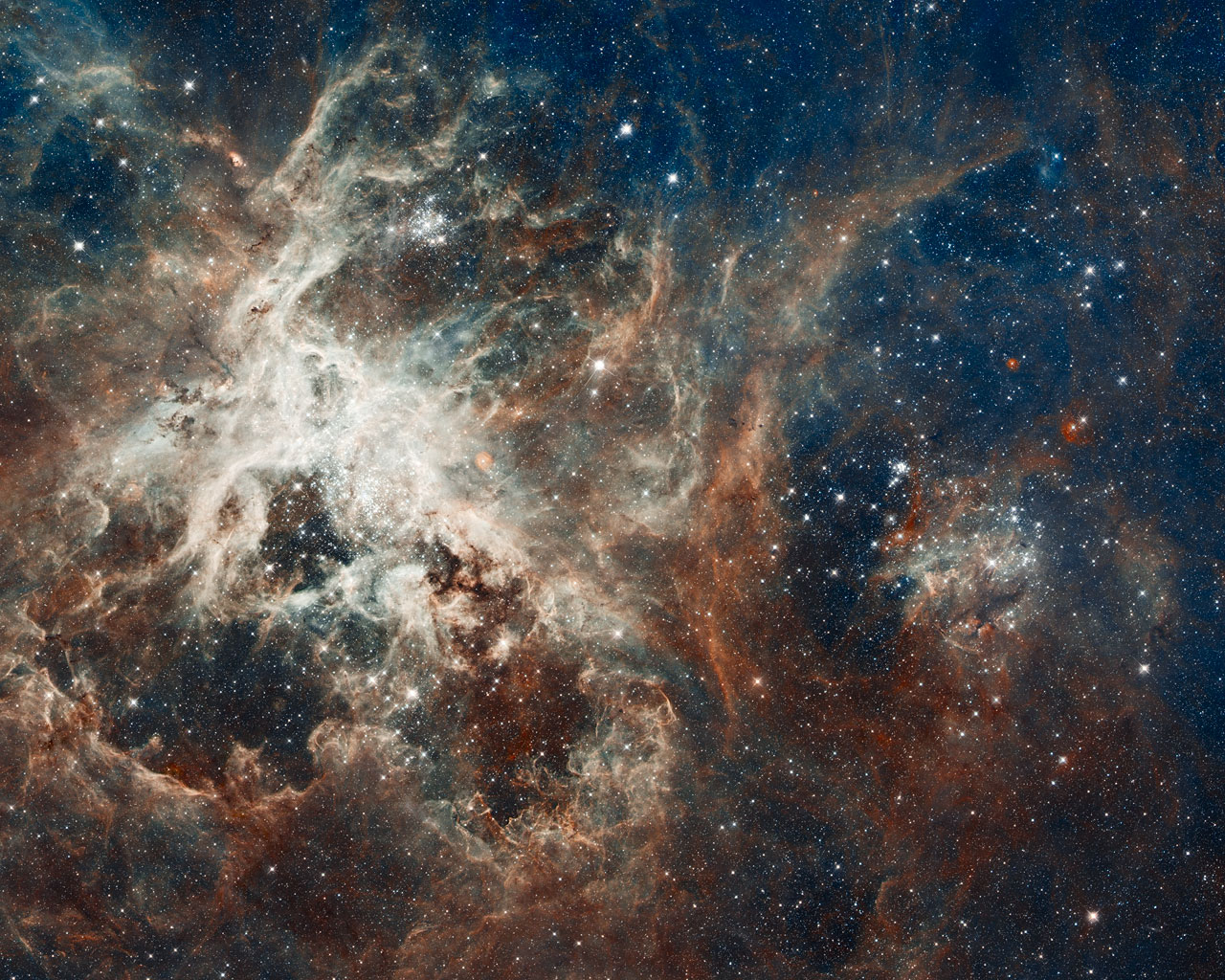 |
| Star Formation in the Tarantula Nebula (May 16, 2012) |
This image is one of the largest mosaics ever created by observations of the Hubble Space Telescope, and was released for the 22nd anniversary of the Hubble's launch.
Tuesday, May 22, 2012
Quarter 4 Astronomer Biography: Subrahmanyan Chandrasekhar
Subrahmanyan Chandrasekhar was an astrophysicist who is best known for is theoretical work on stellar evolution, namely neutron stars and white dwarfs. He was born in Lahore on October 19th, 1910. His parents were Sita Balakrishnan, a "woman of high intellectual attainments," and Chandrasekhara Subrahmanya Ayyar, a Government Service in the Indian Audits and Accounts Department.
Chandra was home schooled until he was twelve, and in 1922, he attended the Hindu High School in Madras. From 1925 to 1930, he attended the Presidency College and earned a bachelor's degree in physics. During his studies at Presidency College, Chandra began his work on white dwarf stars.
About a month after his graduation, Chandra was awarded a Government of India scholarship for graduate studies in Cambridge, England. While in Cambridge, Chandra conducted research under the supervision of Professor R.H. Fowler, and received his Ph.D. In addition to this, he wrote papers on his research of white dwarfs.
From 1933 to 1937, Chandra was elected a Prize Fellowship at Trinity College. While there, he proposed his idea known as astrophysical Chandrasekhar limit. This limit describes the maximum mass of a white dwarf star (about 1.44 solar masses), which is also the minimum mass above which a star collapses into a neutron star or black hole.
In 1937, he was offered a position as a Research Associate at the University of Chicago. Prior to this, in 1936, Chandra married Lalitha Doraiswamy, whom he met at the Presidency College.
At the University of Chicago, he focused his studies on stellar dynamics from 1938 to 1943. He studied radiative transfer (energy transfer through electromagnetic radiation) from 1943 to 1950. From 1952 to 1961 he studied hydrodynamic and hydromagnetic stability. Chandra studied figures of equilibrium (namely shapes of celestial bodies), and in 1962 he started studying relativistic astrophysics, finishing in 1971. Finally, from 1974-1983, Chandra concluded his major studies with the mathematical theory of black holes. In 1983, Chandra received the Nobel prize in physics for his theoretical studies of the physical processes important to the structure and evolution of stars.
Subrahmanyan Chandrasekhar died from heart failure on August 21, 1995. Over his lifetime, he received 20 honorary degrees, was elected to 21 learned societies, and received many awards including: the Gold Medal of the Royal Astronomical Society of London; the Rumford Medal of the American Academy of Arts and Sciences; the Royal Medal of the Royal Society, London; the National Medal of Science; and the Henry Draper Medal of the National Academy of Sciences. Chandra was honored with the naming of one of NASA's observatories after him: the Chandra X-Ray Observatory.
Tuesday, May 15, 2012
Q4 Astronomer Biography Sources
"Chandra :: About Chandra :: Subrahmanyan Chandrasekhar - The Man Behind The Name." Chandra :: About Chandra :: Subrahmanyan Chandrasekhar - The Man Behind The Name. Web. 11 Apr. 2012. <http://chandra.harvard.edu/about/chandra.html>.
Chandrasekhar, Subramanyan. "Autobiography." Subramanyan Chandrasekhar. Nobelprize.org. Web. 11 Apr. 2012. <http://www.nobelprize.org/nobel_prizes/physics/laureates/1983/chandrasekhar-autobio.html>.
"Subrahmanyan Chandrasekhar." Answers.com. Answers. Web. 11 Apr. 2012. <http://www.answers.com/topic/subrahmanyan-chandrasekhar>.
"Subrahmanyan Chandrasekhar." Subrahmanyan Chandrasekhar. The National Accademies. Web. 11 Apr. 2012. <http://www.nas.edu/history/members/chandrasekhar.html>.
"Subrahmanyan Chandrasekhar." Subrahmanyan Chandrasekhar. The University of Chicago, 22 Aug. 1995. Web. 11 Apr. 2012. <http://www-news.uchicago.edu/releases/95/950822.chandrasekhar.shtml>.
Monday, May 14, 2012
APOD 4.7
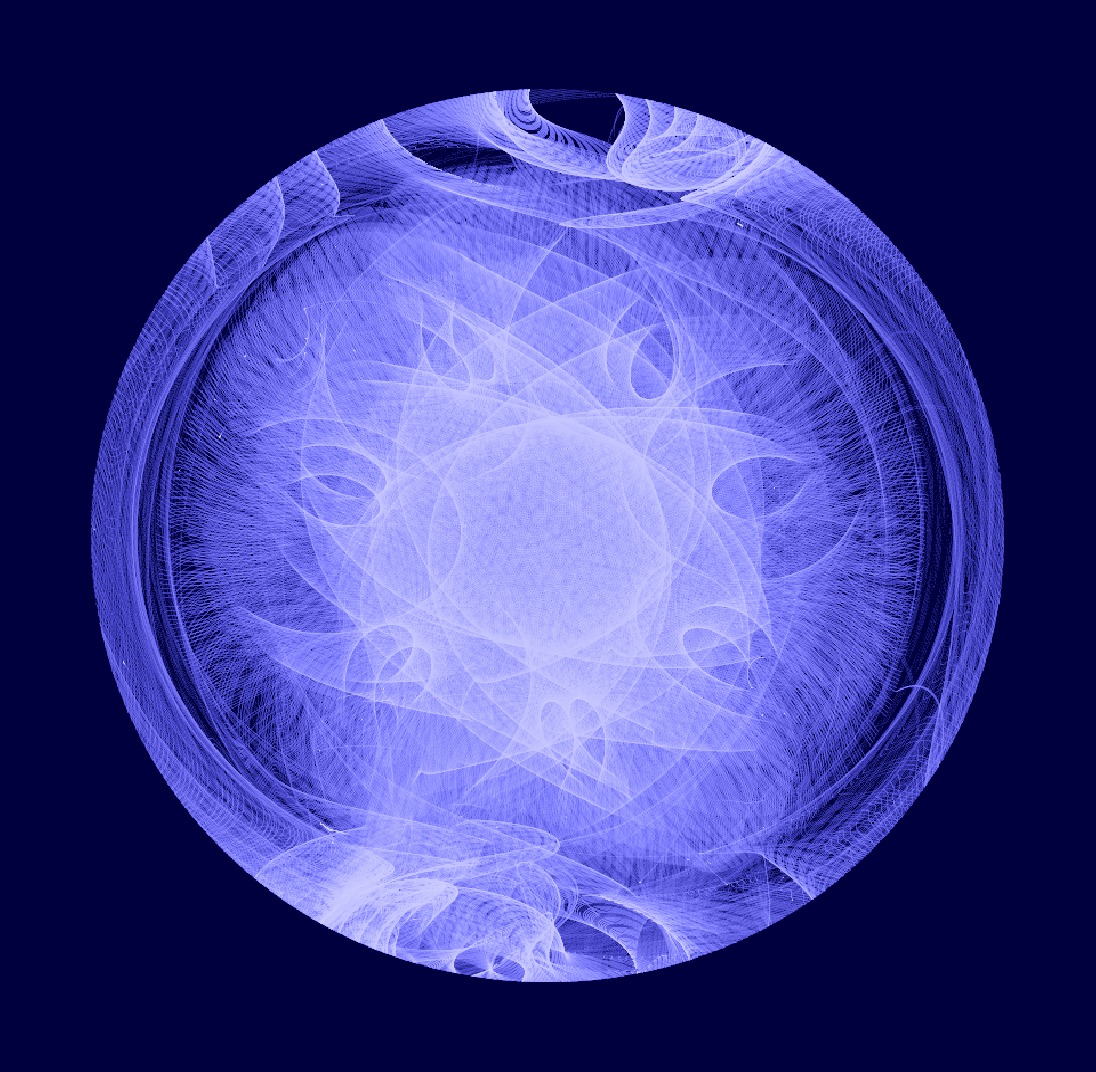 |
| Fermi Epicycles: The Vela Pulsar's Path (May 4, 2012) |
APOD 4.6
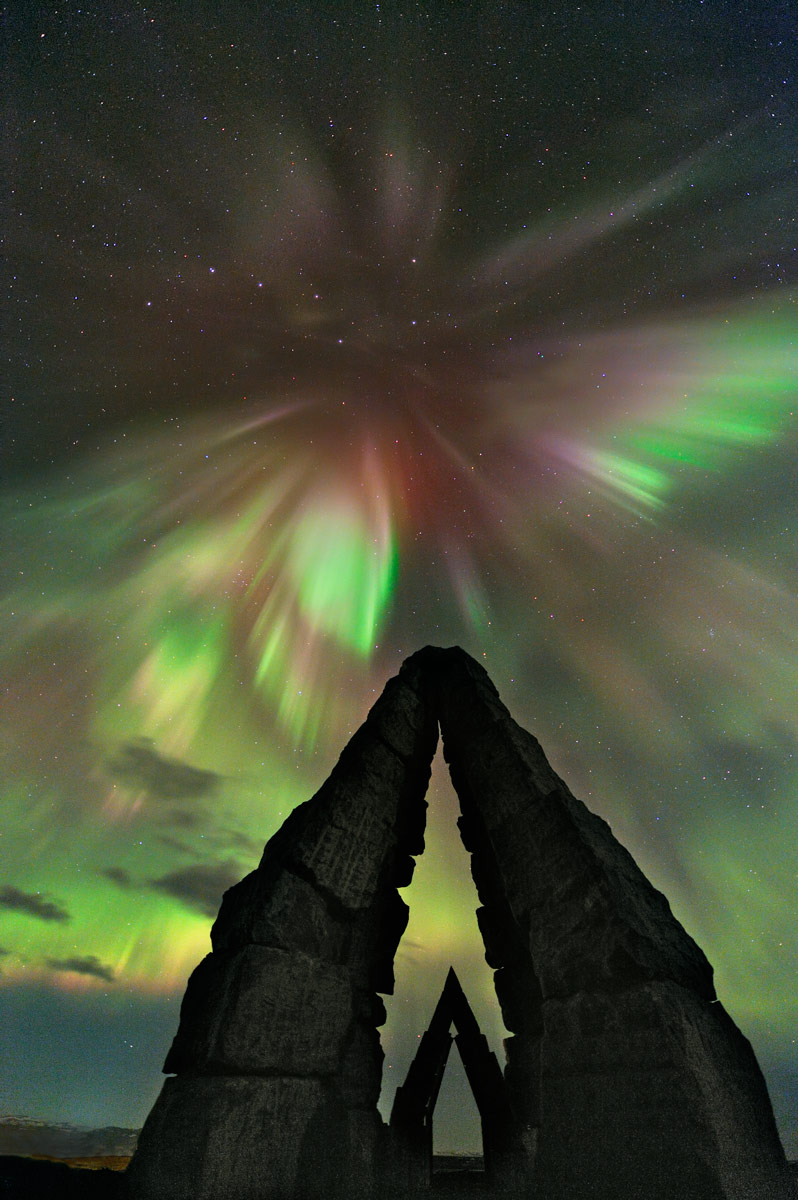 |
| Aurora Over Raufarhöfn (April 30, 2012) |
APOD 4.5
 |
| Yur's Planet (April 12, 2012) |
Sunday, April 29, 2012
Astronomy Cast 4.1: Heisenberg Uncertainty Principle (Episode 252)
Particles aren't just little bundles of matter that fly around, they're waves. This means that have a wavelength that gets refracted and interacts with the material around it. After this realization that particles are also waves, trying to describe what they do and where they are was so different, that scientists had to rethink everything they had already established. This wave-like property brought up the problem of trying to determine the position of a wave because combining the wavelengths and velocities to determine the position, it gets lost because there are no limits on the momentum of the wave, so we no longer know where it is.
So, what Heisenberg came up with was that it is impossible to know both the position and momentum of a particle at any given moment because the more precisely the position is determined, the less precisely the momentum is known in this instant, and vice versa. Further, Heisenberg argued that such concepts as orbits of electrons do not exist in nature unless and until we observe them. This is because one cannot know the precise position and momentum of a particle at a given instant, so its future cannot be determined; one cannot calculate the precise future motion of a particle, but only a range of possibilities for the future motion of the particle.
Heisenberg's principle does not state that everything is uncertain, just that there are limits to certainty and uncertainty when dealing with objects at the subatomic level.
So, what Heisenberg came up with was that it is impossible to know both the position and momentum of a particle at any given moment because the more precisely the position is determined, the less precisely the momentum is known in this instant, and vice versa. Further, Heisenberg argued that such concepts as orbits of electrons do not exist in nature unless and until we observe them. This is because one cannot know the precise position and momentum of a particle at a given instant, so its future cannot be determined; one cannot calculate the precise future motion of a particle, but only a range of possibilities for the future motion of the particle.
Heisenberg's principle does not state that everything is uncertain, just that there are limits to certainty and uncertainty when dealing with objects at the subatomic level.
Friday, April 27, 2012
APOD 4.4
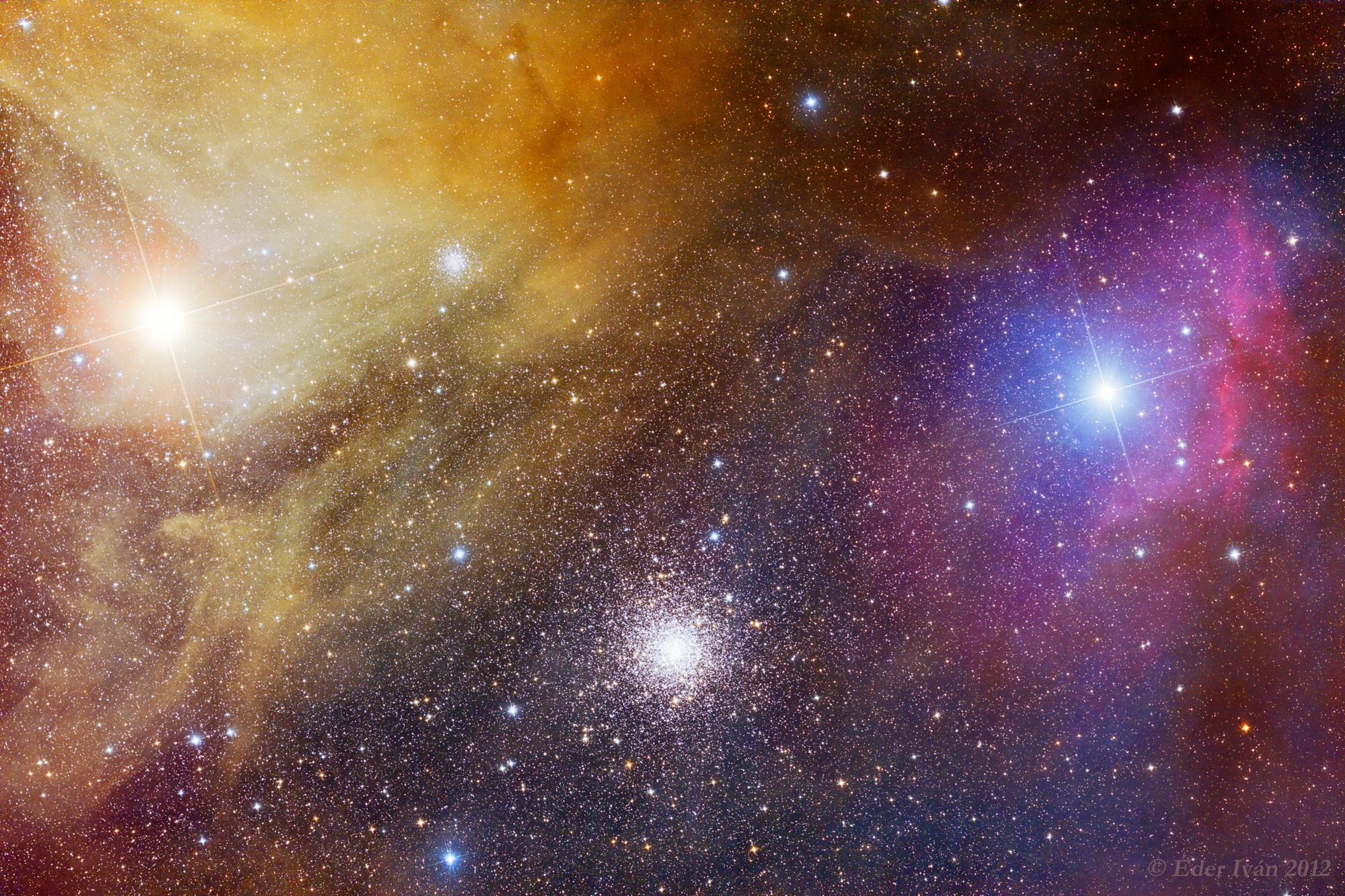 |
| Antares and Clouds (April 17, 2012) |
Friday, April 20, 2012
APOD 4.3
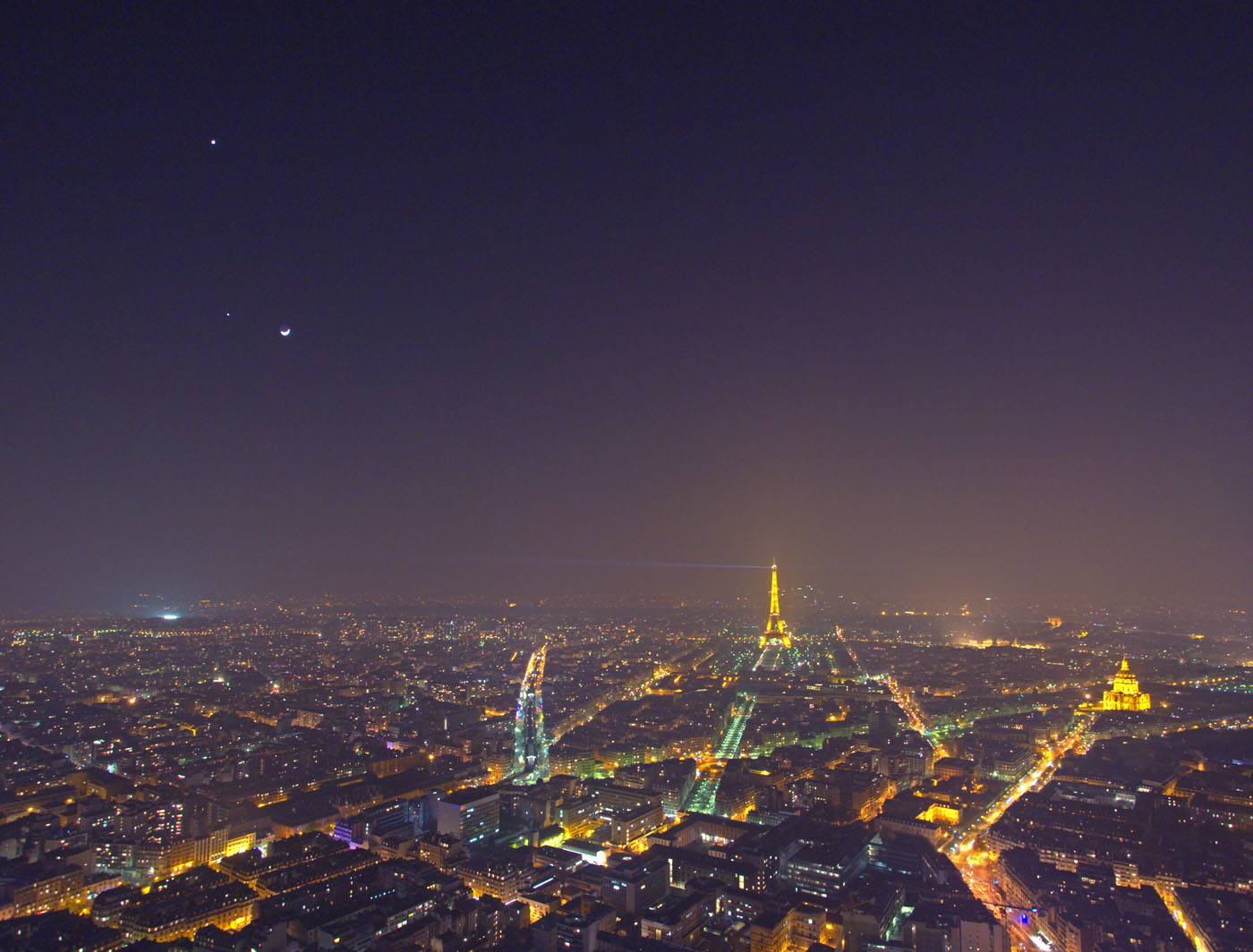 |
| Paris by Night (March 31, 2012) |
This same conjunction could be seen in other parts of the world, too. For example, I saw it in Sarasota, Florida.
At the moment, there are four planets that are visible in the sky: Jupiter, Venus, Mars, and Saturn.
APOD 4.2
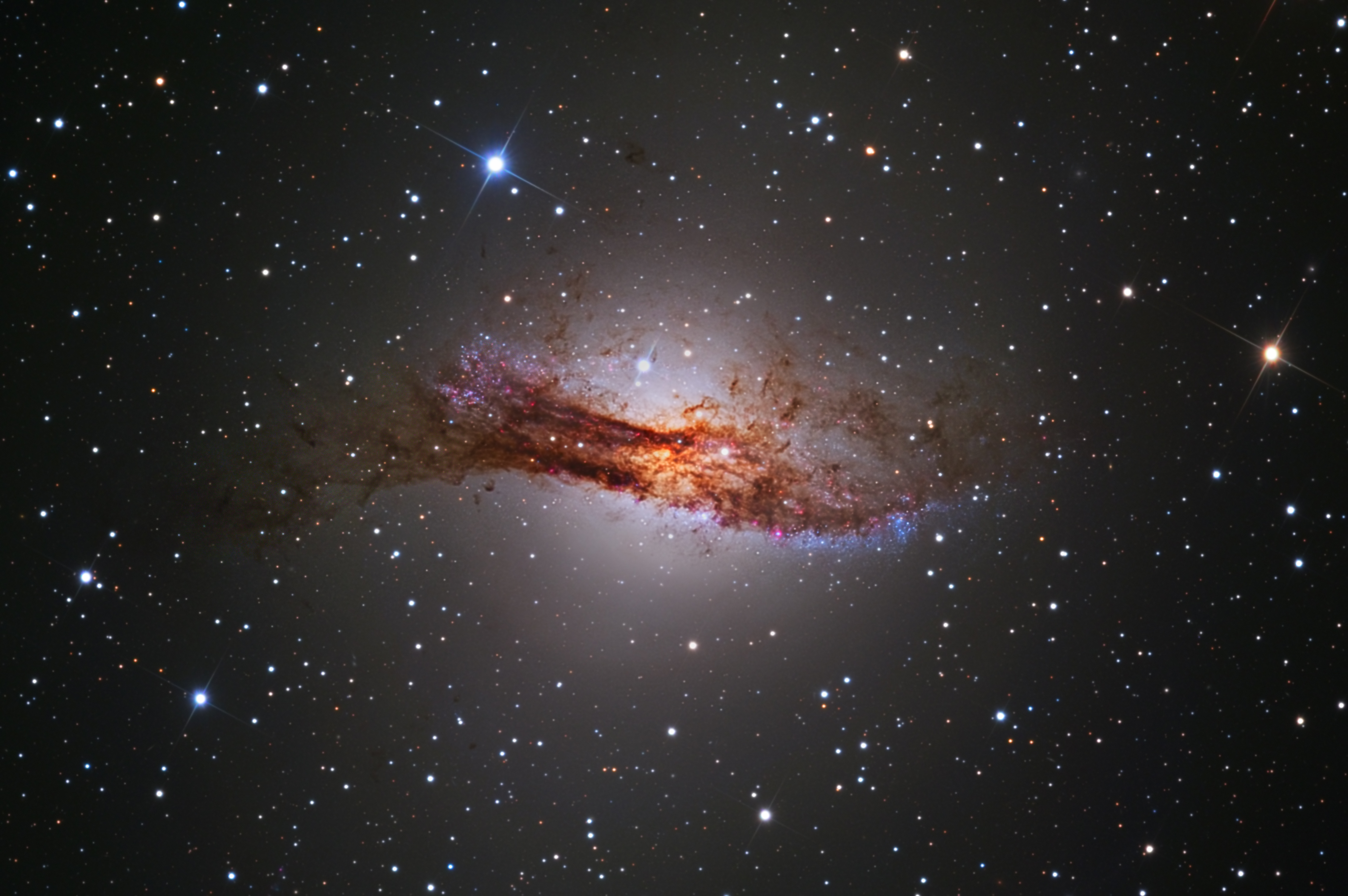 |
| Centaurus A (April 4, 2012) |
Thursday, March 29, 2012
APOD 4.1
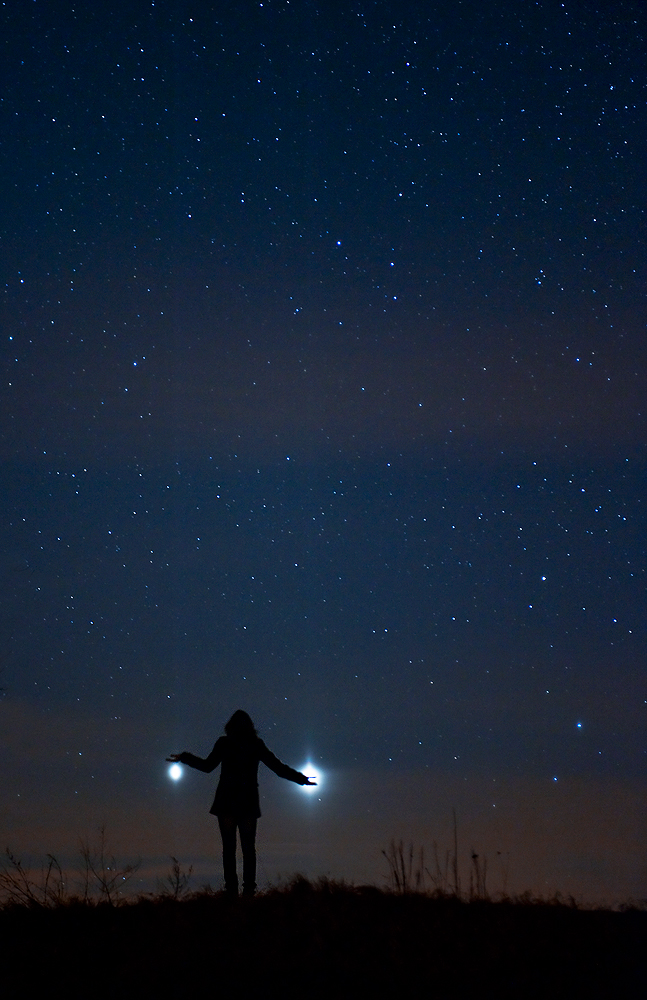 |
| Jupiter and Venus from Earth (March 18, 2012) |
Wednesday, March 28, 2012
Astronomy Cast 3.1: Schrodinger’s Cat (Episode 249)
Schrodinger’s Cat's is an illustration in quantum theory of superposition describing that we can never truly know what is happening to something or what it's doing if we can't see it. The experiment was done by Erwin Schrödinger in 1935. The basic set up of the experiment is a living cat is placed in a steel chamber along with device containing a vial of a very small about of hydrocyanic acid (which is a radioactive substance). Once the substance starts to decay, it triggers a mechanism that breaks the vial, releasing the acid, which would kill the cat. Because the container is enclosed and the observer cannot see inside, they are unaware if the substance has started to decay, and if the cat is dead. Since there is no way of knowing without opening the box, the cat is considered to be dead and alive in what is known as a superposition of states. It is concluded that because the outcome is determined my the observation, the outcome does not exist unless the observation is made.
APOD 3.8
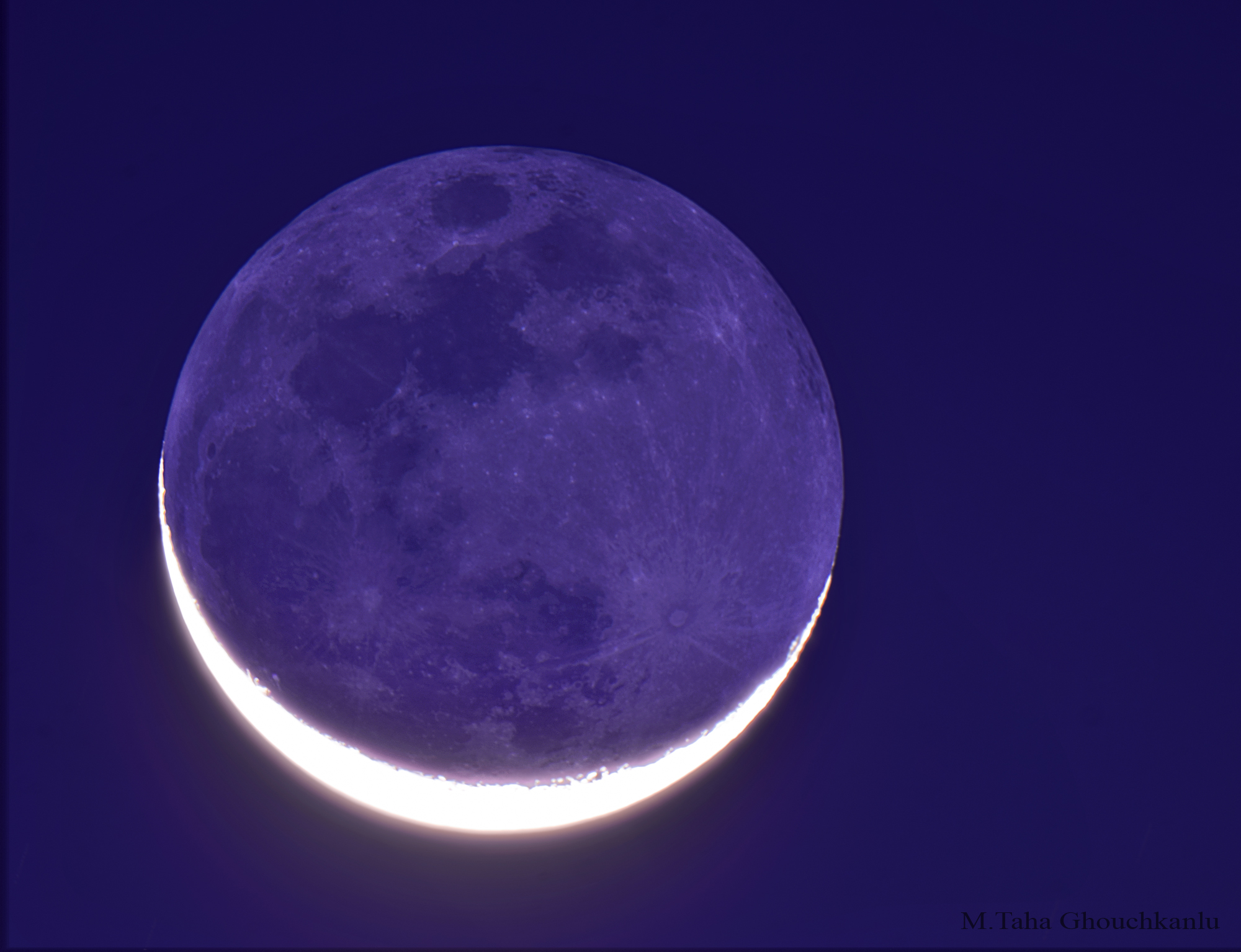 |
| The New Moon in the Old Moon's Arms (March 24, 2012) |
Wednesday, March 21, 2012
Supernova Remnants
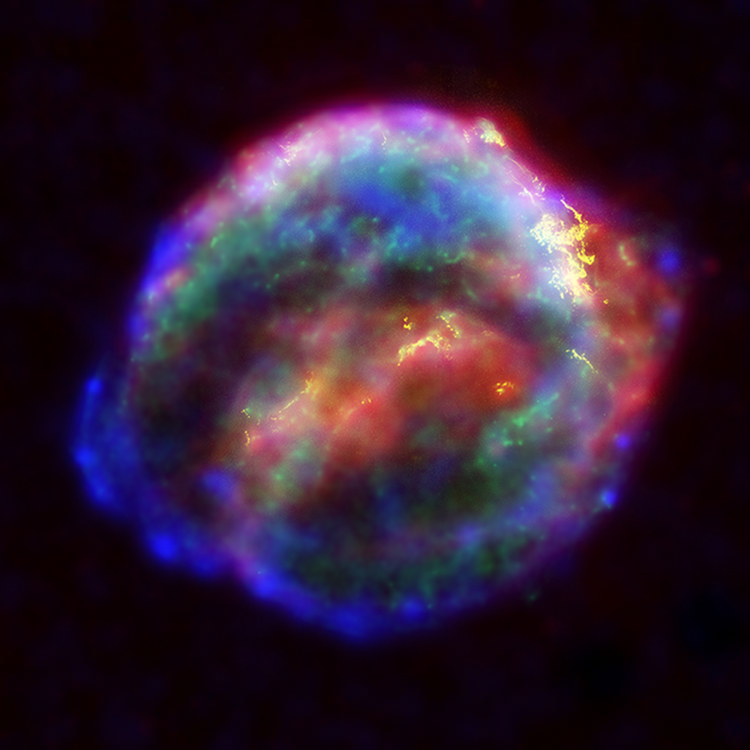 |
| SN 1604 (Kepler's Supernova) |
 |
| W49B |
 |
| Veil Nebula |
Friday, March 9, 2012
APOD 3.7
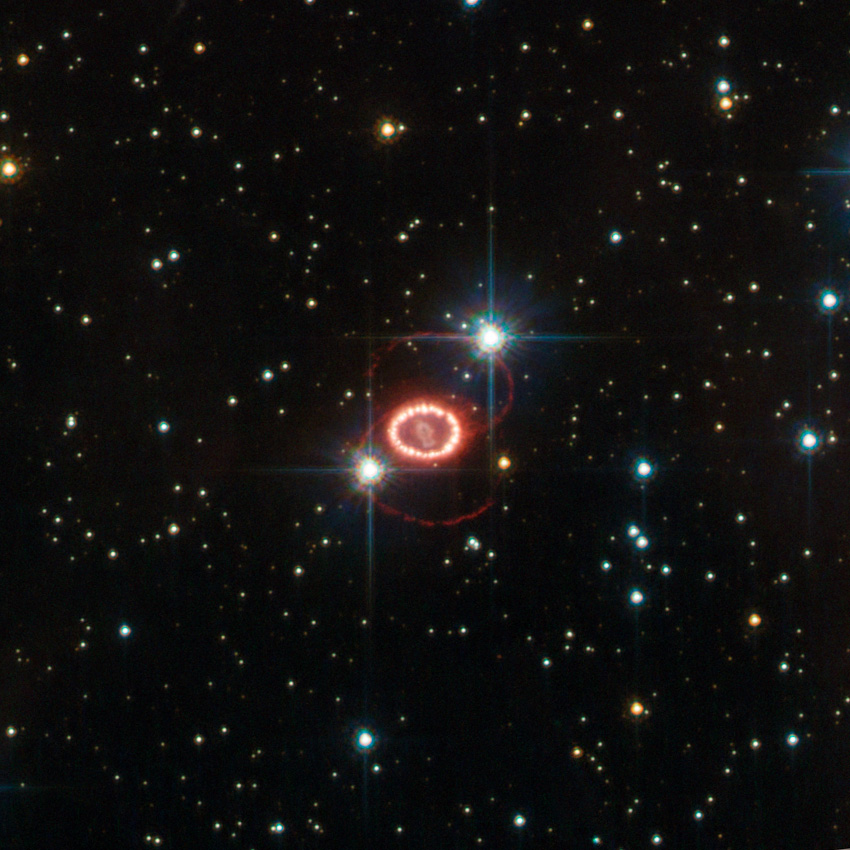 |
| The Mysterious Rings of Supernova 1987A (February 26, 2012) |
Friday, March 2, 2012
Q3 Astronomer Biography: Edward Emerson Bernard

Edward Emerson Bernard was an American astronomer and astronomical photographer born on December 16, 1857, in Nashville, Tennessee. Bernard was schooled by his mother until he was nine, and then was employed for 16 years for a photographer in Nashville where he was trained in photographic processing. This training and his knowledge of photographic lenses became useful in his career as an astronomer.
Bernard became interested in astronomy in 1876 after reading a book about astronomy and building his first telescope out of a broken spyglass. He continued working as a photographer's assistant while studying astronomy at night.
On May 12, 1881, Barnard discovered his first comet, which however he did not announce. He found his second comet on September 17 of the same year, and another one on September 13, 1882. After these discoveries, he was accepted to Vanderbilt University and graduated in 1887 with a bachelor's in science. He was then appointed junior astronomer at the recently established Lick Observatory, which had a new 36-inch telescope. This was the largest telescope in the world, at the time. In 1892, Bernard discovered Jupiter's fifth moon, Amalthea. He later discovered the sixth, seventh, eighth, and ninth moons of Jupiter as well. Bernard also started to photograph the Milky Way Galaxy, capturing the intricate designs which he became famous for.
In 1895, Bernard accepted a position at the Yerkes Observatory, and started observing using the 40-inch photographic telescope in 1897. Barnard next began the micrometric triangulation of some of the globular clusters, which he continued for nearly 25 years, hoping to detect motions of the individual stars.
In 1916 he discovered the proper motion of the 9.5 magnitude star cataloged as Munich 15040 or LFT 1385 located in the constellation Ophiuchus. This star later became known as Bernard's Star. In his lifetime, Edward Emerson Bernard collected 1400 negatives of comets, nearly 4000 plates of the Milky Way and other star fields, published more than 900 papers, had the honor having a Mars crater, moon crater, asteroid, and residence hall at Vanderbilt University after him. he died on February 6, 1923 at the age of 66.
APOD 3.6
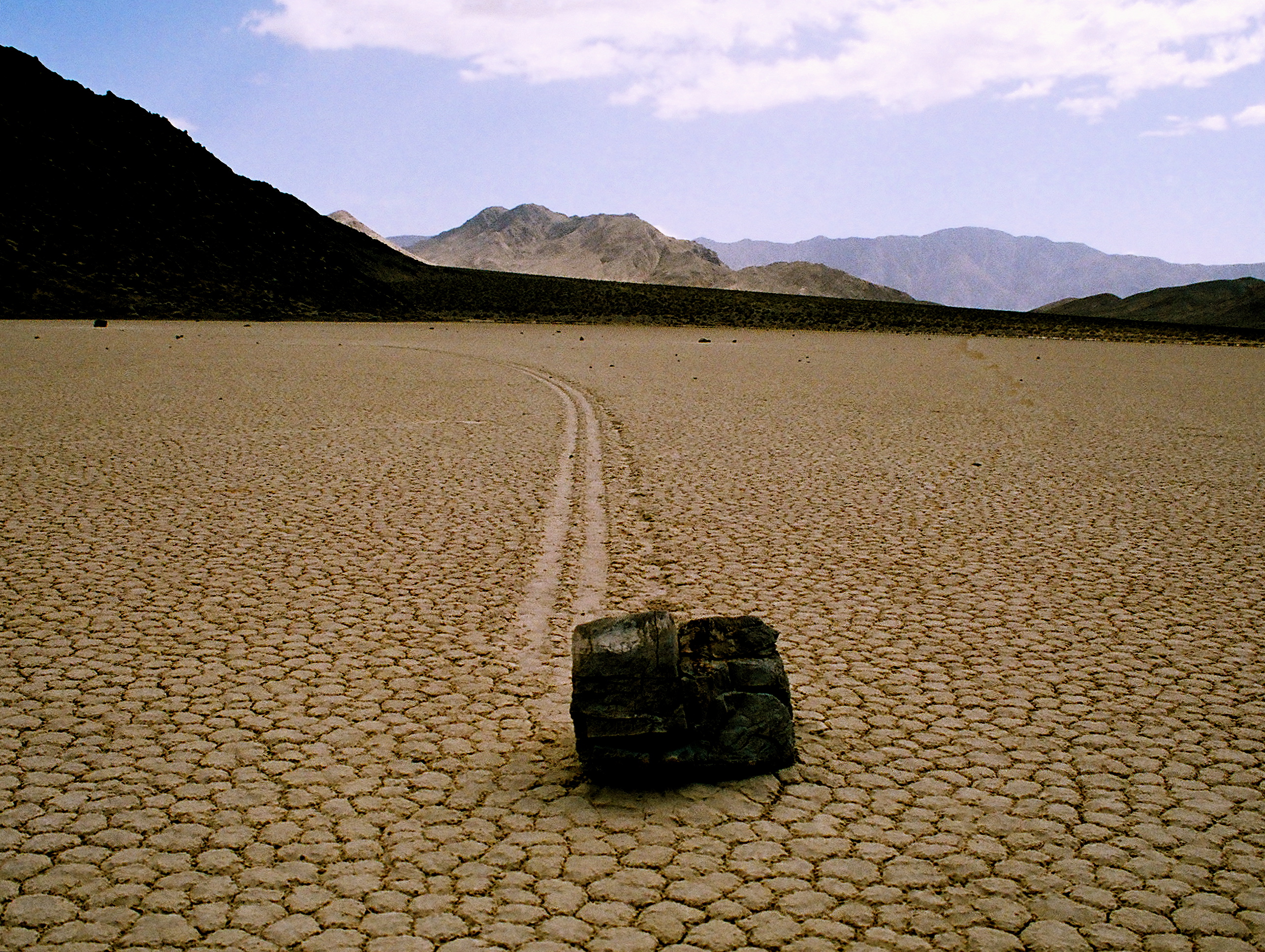 |
| A Sailing Stone in Death Valley (February 22, 2012) |
Wednesday, February 22, 2012
Q3 Astronomer Biography Sources
Atkinson, Neill. "Barnard, William Edward - Biography." Dictionary of New Zealand Biography. Web. 22 Feb. 2012. <http://www.teara.govt.nz/en/biographies/4b5/1>.
"Edward Emerson Barnard (1857-1923)." SEDS Messier Database. Web. 22 Feb. 2012. <http://messier.seds.org/xtra/Bios/barnard.html>.
"Edward Emerson Barnard Biography." BookRags. BookRags. Web. 22 Feb. 2012. <http://www.bookrags.com/biography/edward-emerson-barnard/>.
"Edward Emerson Barnard (1857-1923)." SEDS Messier Database. Web. 22 Feb. 2012. <http://messier.seds.org/xtra/Bios/barnard.html>.
"Edward Emerson Barnard Biography." BookRags. BookRags. Web. 22 Feb. 2012. <http://www.bookrags.com/biography/edward-emerson-barnard/>.
The Formation of Stars

A star is formed out of cloud of cool, dense molecular gas that collapses and increases in density. This can happen when the cloud collides with another dense molecular cloud or it is near enough to another cloud to encounter the pressure caused by a giant supernova. Multiple stars can be formed at once with the collision of two galaxies. In both instances, heat from the mutual gravity pulling all the material inward is required in order to fuel the reaction. The newborn star is called a protostar.
Next, the protostar can become a brown dwarf (a sub-stellar object that cannot maintain high enough temperatures to perpetuate hydrogen fusion to helium) if it's a small star. If it's a medium or large protostar, it can either undergo a proton-proton chain reaction to convert hydrogen to helium, or a carbon-nitrogen-oxygen cycle to convert hydrogen to helium. The difference is that the carbon-nitrogen-oxygen cycle occurs at much higher temperatures. After any of these processes, a new star is formed.
From there, the life cycle depends on how quickly the star consumes hydrogen. Once it has consumed most of its hydrogen, it is considered to be mature.
Friday, February 17, 2012
APOD 3.5
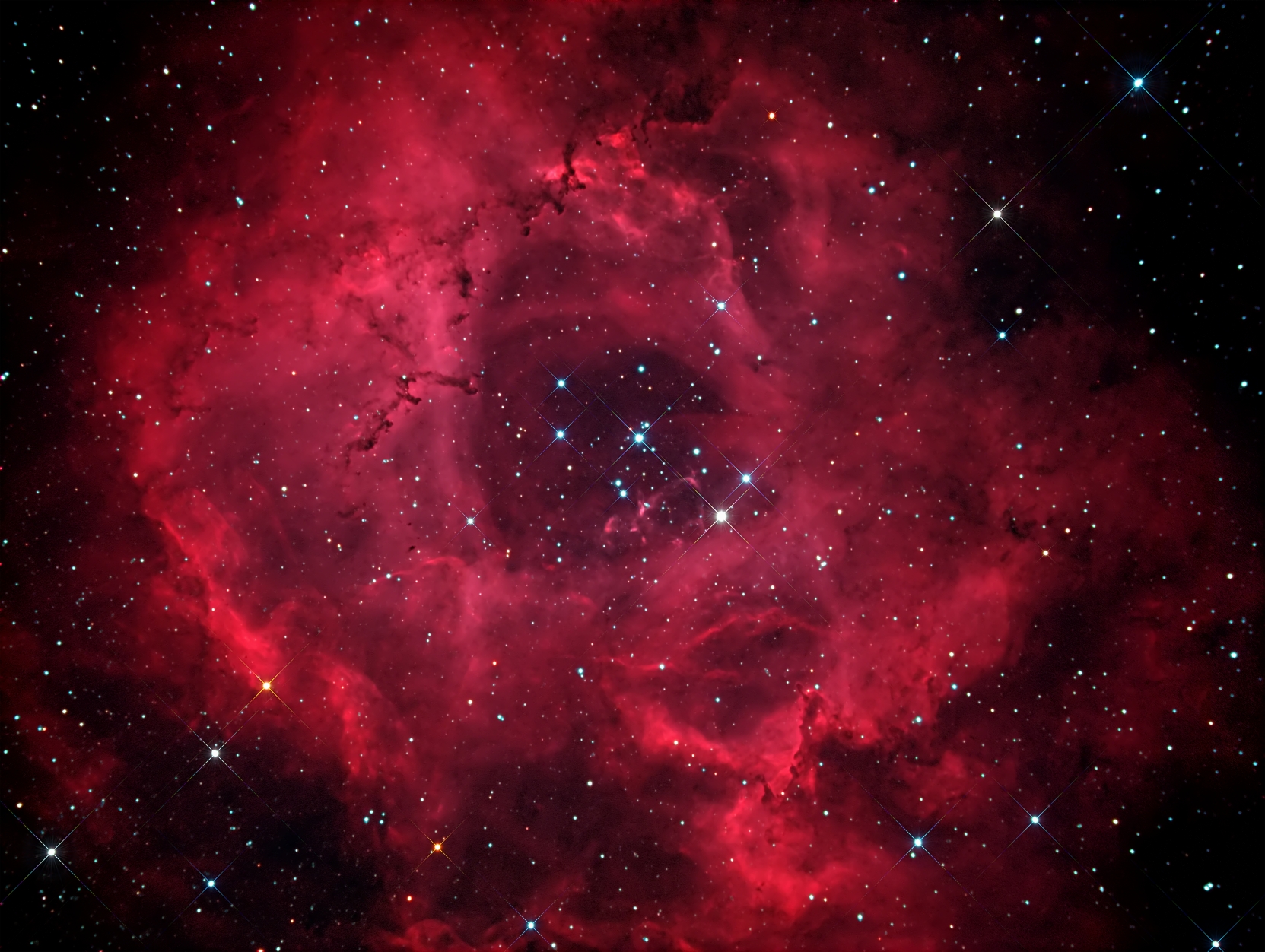 |
| The Rosette Nebula (February 14, 2012) |
Monday, February 13, 2012
Observation on February 12, 2012
Date: Sunday February 12, 2012
Time: 7:00 to 9:00 EST
Temperature: 47 degrees F
Location: Pine View School, Osprey, FL
Weather: Partly cloudy
It was quite chilly at our stargaze last night, but that did not stop us from seeing the stars! Through the telescope we were able to see Jupiter, and we viewed the Pleiades through binoculars.
We were able to identify the constellations Pegasus, Andromeda, Cassiopeia, Perseus, Taurus, Orion, Eridanus, Canis Major and Minor, Cancer, Gemini, and part of Leo and Ursa Major.
We were able to identify M42, the Hyades, and the stars Betelgeuse, Rigel, Aldebaran, Procyon, Sirius (the brightest star in the winter sky), Pollux, and Castor.
During the night we were also able to identify Venus and Jupiter located about 17 or 18 degrees apart from one another.
Though it was chilly and a little cloudy, we were able to spot so many things!
Time: 7:00 to 9:00 EST
Temperature: 47 degrees F
Location: Pine View School, Osprey, FL
Weather: Partly cloudy
It was quite chilly at our stargaze last night, but that did not stop us from seeing the stars! Through the telescope we were able to see Jupiter, and we viewed the Pleiades through binoculars.
We were able to identify the constellations Pegasus, Andromeda, Cassiopeia, Perseus, Taurus, Orion, Eridanus, Canis Major and Minor, Cancer, Gemini, and part of Leo and Ursa Major.
We were able to identify M42, the Hyades, and the stars Betelgeuse, Rigel, Aldebaran, Procyon, Sirius (the brightest star in the winter sky), Pollux, and Castor.
During the night we were also able to identify Venus and Jupiter located about 17 or 18 degrees apart from one another.
Though it was chilly and a little cloudy, we were able to spot so many things!
APOD 3.4
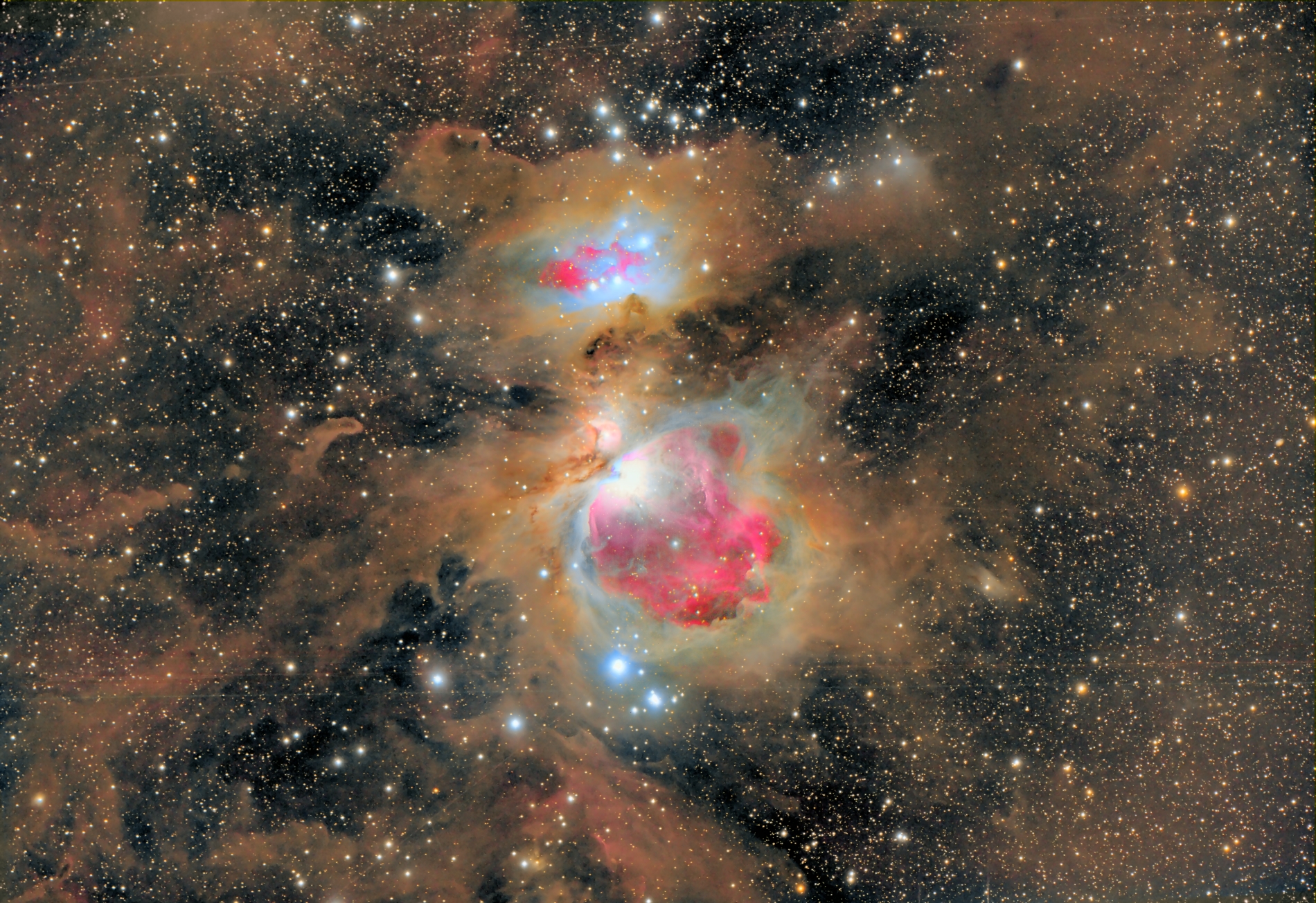 |
| Dust of the Orion Nebula (February 6, 2012) |
Friday, February 3, 2012
APOD 3.3
 |
| La Silla Star Trails North and South (February 2, 2012) |
APOD 3.2
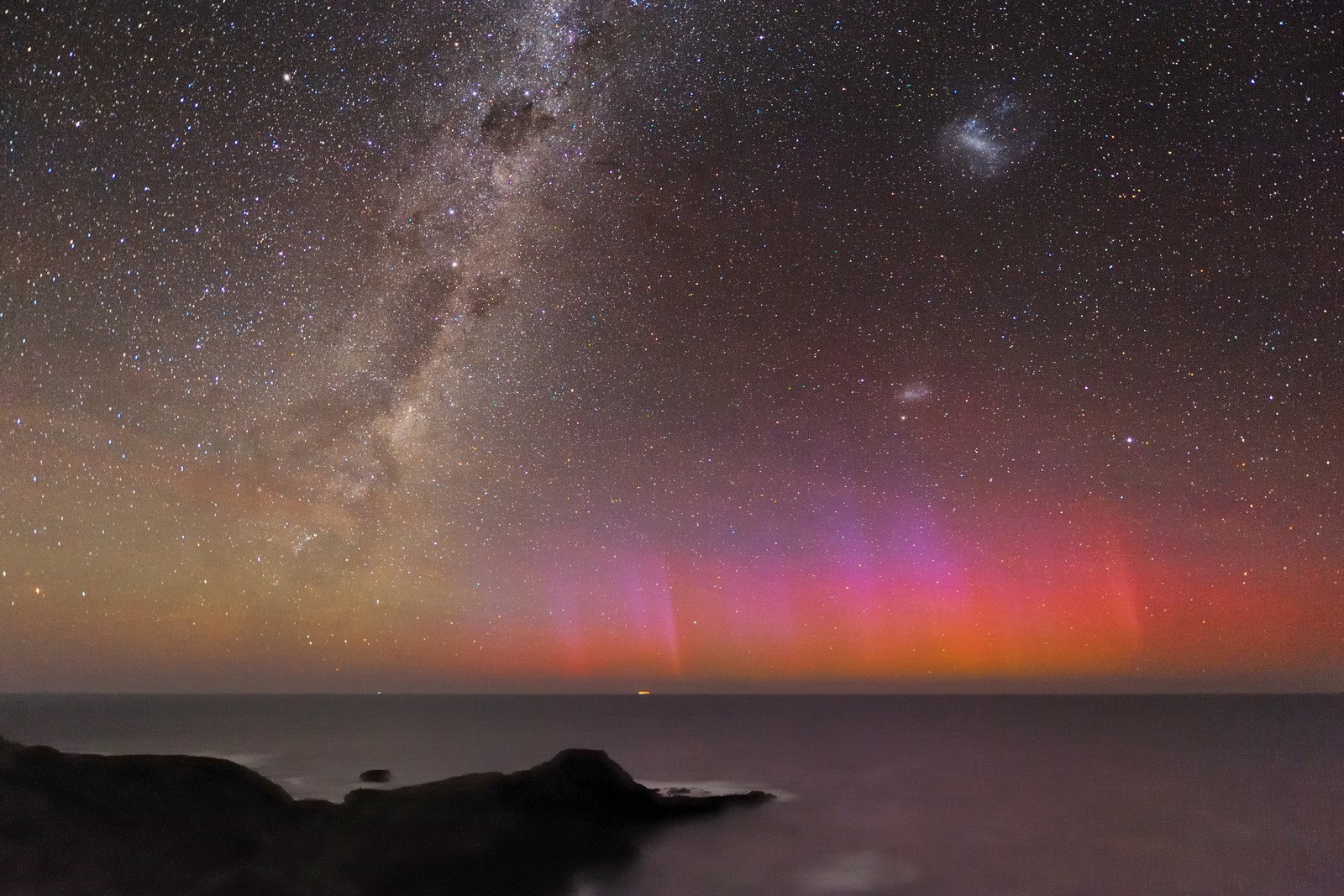 |
| Red Aurora Over Australia (February 1, 2012) |
Friday, January 20, 2012
APOD 3.1
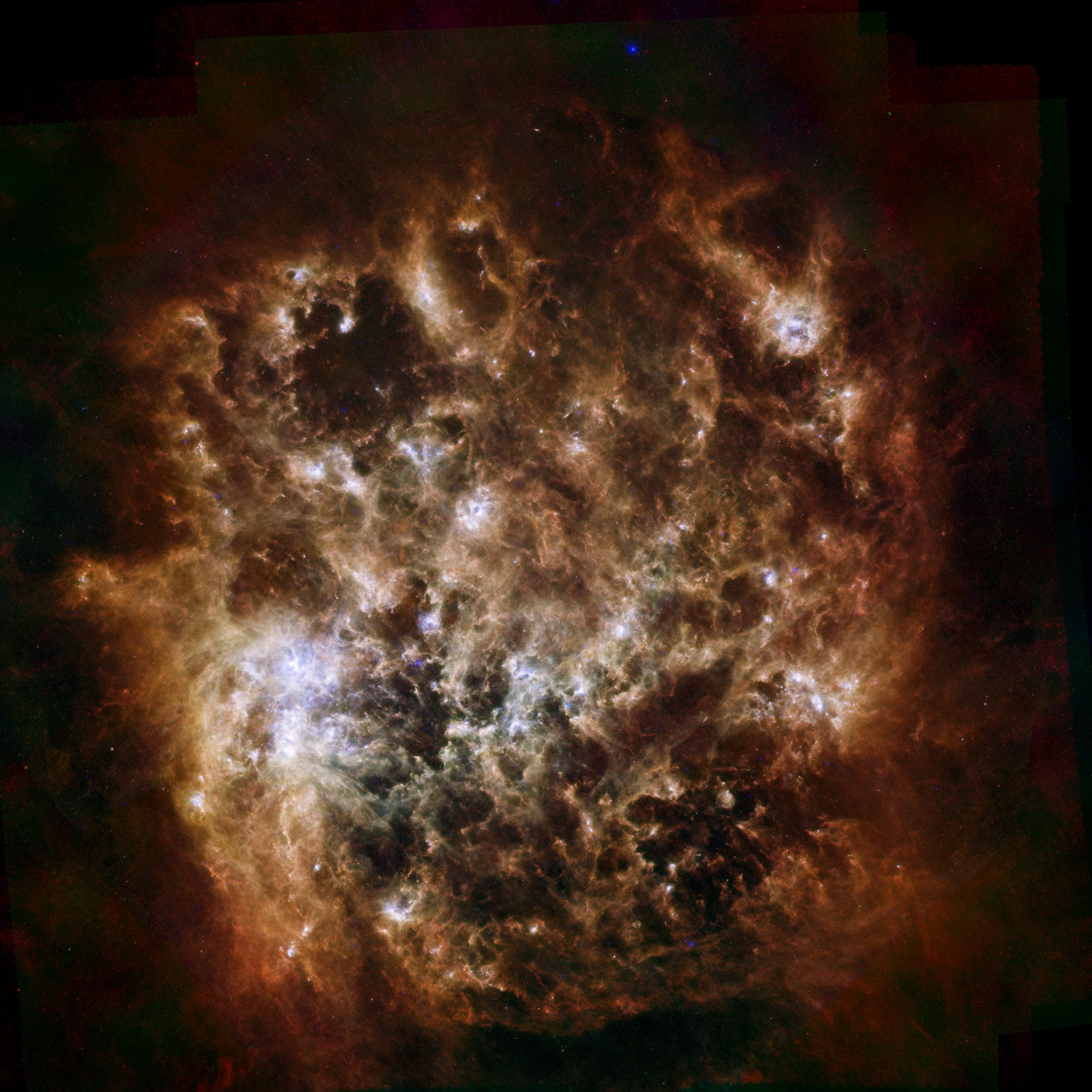 |
| Infrared Portrait of the Large Magellanic Cloud (January 15, 2012) |
Friday, January 13, 2012
Astronomy Cast 2.2: Orion (Episode 224)
The constellation Orion can be found in the winter sky. Orion was a hunter, and he had a battle with Scorpius, the scorpion. They both died and were put into the heaven,s but on opposite sides of the sky. Scorpio is up high in the sky six months before Orion is up high in the sky. Historians are not sure they had the story first, and then they mapped it back to the stars, or is someone pictures the stars, and then they came up with the story. Despite this discrepancy, the story is accepted and people enjoy to identify the constellation--it is very well known. In the constellation are two important stars: Betelgeuse, a red super giant star, and Rigel a hotter, younger star that appears blue. All the stars in the constellation have ranging differences in distance from the Earth, but because they are all different sizes too, they appear the same brightness. This change arrangement of stars is a lucky one!
Astronomy Cast 2.1: Exotic Life (Episode 209)
Recently, in Mono Lake in California, a single-celled bacteria was found that has the ability to replace phosphorous DNA with arsenic. This is such a big deal because they can essentially change the entire structure of their DNA, and become a completely different organism from those found on Earth. What is also interesting is that they live in a lake with high levels of arsenic, which would be deadly for most organisms. Because of this extreme condition, they evolved to fit their surroundings. Because of this discovery, scientists are trying to get funding to search for alien life in places other than those that have water because we now know that organisms exist that are different from humans structurally.
APOD 2.8
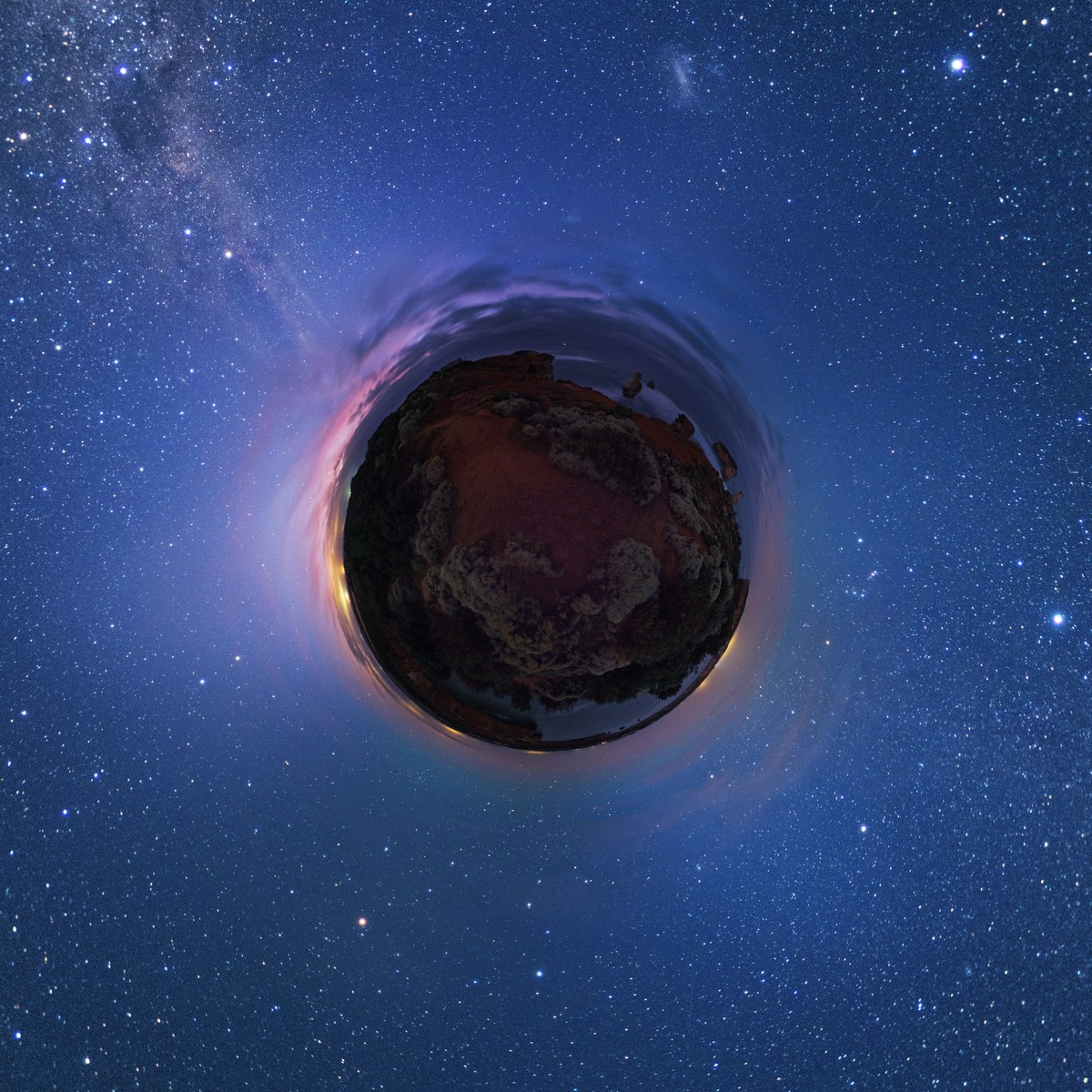 |
| Little Planet Lovejoy (January 11, 2012) |
Also in the picture is the Southern Cross in the top left corner of the frame, and Orion directly to the right of Earth's equator.
Thursday, January 12, 2012
Quarter 2 Astronomer Biography: Nicolas Lacaille

Before this, Lacaille studued rhetoric and philosophy at Collège de Lisieux in France starting in 1729. He was able to attend this school because his father paid, but when Lacaille's father died in 1731, he lost his tuition money. Nicolas Lacaille was able to find a beneficiary, the Duke of Bourbon, to support his studies. After, Lacaille enrolled in a three-year study at the college of Navarre, in order to obtain ordination for priesthood. While studying here, he first encountered mathematics and private studies of astronomy. He graduated in 1736 with a masters and bachelors in Theology, but never obtained ordination for priesthood.
In 1739, Nicolas Lacaille stared working for Jacques Cassini and Jean-Dominique Maraldi at Paris observatory, was involved in the geodesic survey of France. In 1741, however, Lacaille was elected to the Royal Academy of Sciences in Paris, and took his post in the Collège Mazarin where he established an observatory. He began making observations, mainly focusing on Earth's orbit, parallaxes, planetary orbits, comets, and star catalogs. Lacaille also wrote many textbooks on astronomy, mathematics, mechanics, and optics. His books were read many places, had many editions and even were translated to different languages.
While working in Paris, Lacaille became interested in exploring the southern skies and decided to enter an expedition to the Cape of Good Hope. August 6, 1751, Lacaille established an observatory in South Africa and observed the skies for a year. He was able to determine the positions of about 9,800 stars between the celestial south pole and the tropic of Capricorn. Among the stars were 42 nebulous stars, 240 principle stars, and 1,930 stars visible to the naked eye that were extracted for creating a planisphere. He also created 15 constellations, 14 of which are still used today, and took many measurements of the positions of the Moon, the Sun, Venus, and Mars in an effort to obtain parallaxes. Lacaille finally returned home to Paris June 28, 1754.
Nicolas Lacaille made huge advancements in the field of astronomy. The fourteen constellations maned by Lacaille were: Antlia, Caelum, Circinus, Fornax, Horologium, Mensa, Microscopium, Norma, Octans, Pictor, Pyxis, Reticulum, Sculptor, and Telescopium. He was honored for his accomplishments by having a crater on the Moon (La Caille) being named after him in 1961. An asteroid discovered in 1960 was named Asteroid Lacaille in honor of Nicolas.
Friday, January 6, 2012
APOD 2.7
 |
| To Fly Free in Space (January 1, 2012) |
This photograph captures one attention because of the detailed cloud-cover of Earth, contrasted with the completely black space and McCandless. This contrast makes the viewer feel like they could get lost in the picture, as one could get lost in space.
Wednesday, January 4, 2012
Q2 Astronomer Biography Sources
"Lacaille, Nicolas-Louis De." Complete Dictionary of Scientific Biography. Vol. 7. Detroit: Charles Scribner's Sons, 2008. 542-545. Gale Virtual Reference Library. Web. 4 Jan. 2012.
Frommert, Hartmut, and Christine Kronberg. "Nicholas Louis De Lacaille (1713-62)." SEDS Messier Database. Web. 04 Jan. 2012. <http://messier.seds.org/xtra/Bios/lacaille.html>
Lesikar, Arnold V. "Nicolas Louis De Lacaille." The Dome of the Sky. Web. 04 Jan. 2012. <http://domeofthesky.com/clicks/deLacaille.html>
"DOC: Abbe Nicolas Louis De Lacaille." Fortunecity.com. Willmann-Bell, Inc, 3 Dec. 1997. Web. 04 Jan. 2012. <http://www.fortunecity.com/roswell/borley/49/lacaille.htm>.
Subscribe to:
Comments (Atom)