 |
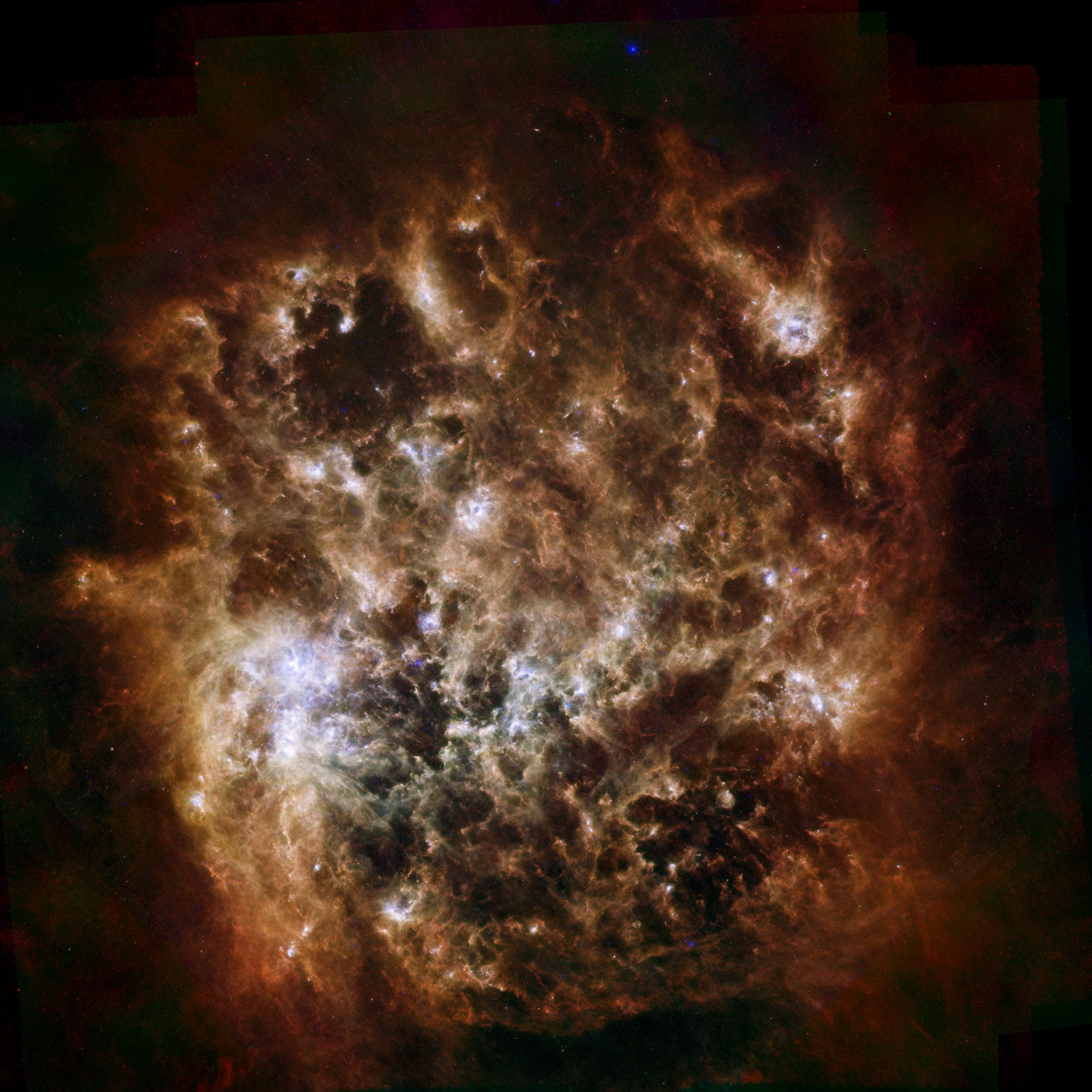
| Infrared Portrait of the Large Magellanic Cloud (January 15, 2012) |
Friday, January 20, 2012
APOD 3.1

Friday, January 13, 2012
Astronomy Cast 2.2: Orion (Episode 224)
The constellation Orion can be found in the winter sky. Orion was a hunter, and he had a battle with Scorpius, the scorpion. They both died and were put into the heaven,s but on opposite sides of the sky. Scorpio is up high in the sky six months before Orion is up high in the sky. Historians are not sure they had the story first, and then they mapped it back to the stars, or is someone pictures the stars, and then they came up with the story. Despite this discrepancy, the story is accepted and people enjoy to identify the constellation--it is very well known. In the constellation are two important stars: Betelgeuse, a red super giant star, and Rigel a hotter, younger star that appears blue. All the stars in the constellation have ranging differences in distance from the Earth, but because they are all different sizes too, they appear the same brightness. This change arrangement of stars is a lucky one!
Astronomy Cast 2.1: Exotic Life (Episode 209)
Recently, in Mono Lake in California, a single-celled bacteria was found that has the ability to replace phosphorous DNA with arsenic. This is such a big deal because they can essentially change the entire structure of their DNA, and become a completely different organism from those found on Earth. What is also interesting is that they live in a lake with high levels of arsenic, which would be deadly for most organisms. Because of this extreme condition, they evolved to fit their surroundings. Because of this discovery, scientists are trying to get funding to search for alien life in places other than those that have water because we now know that organisms exist that are different from humans structurally.
APOD 2.8
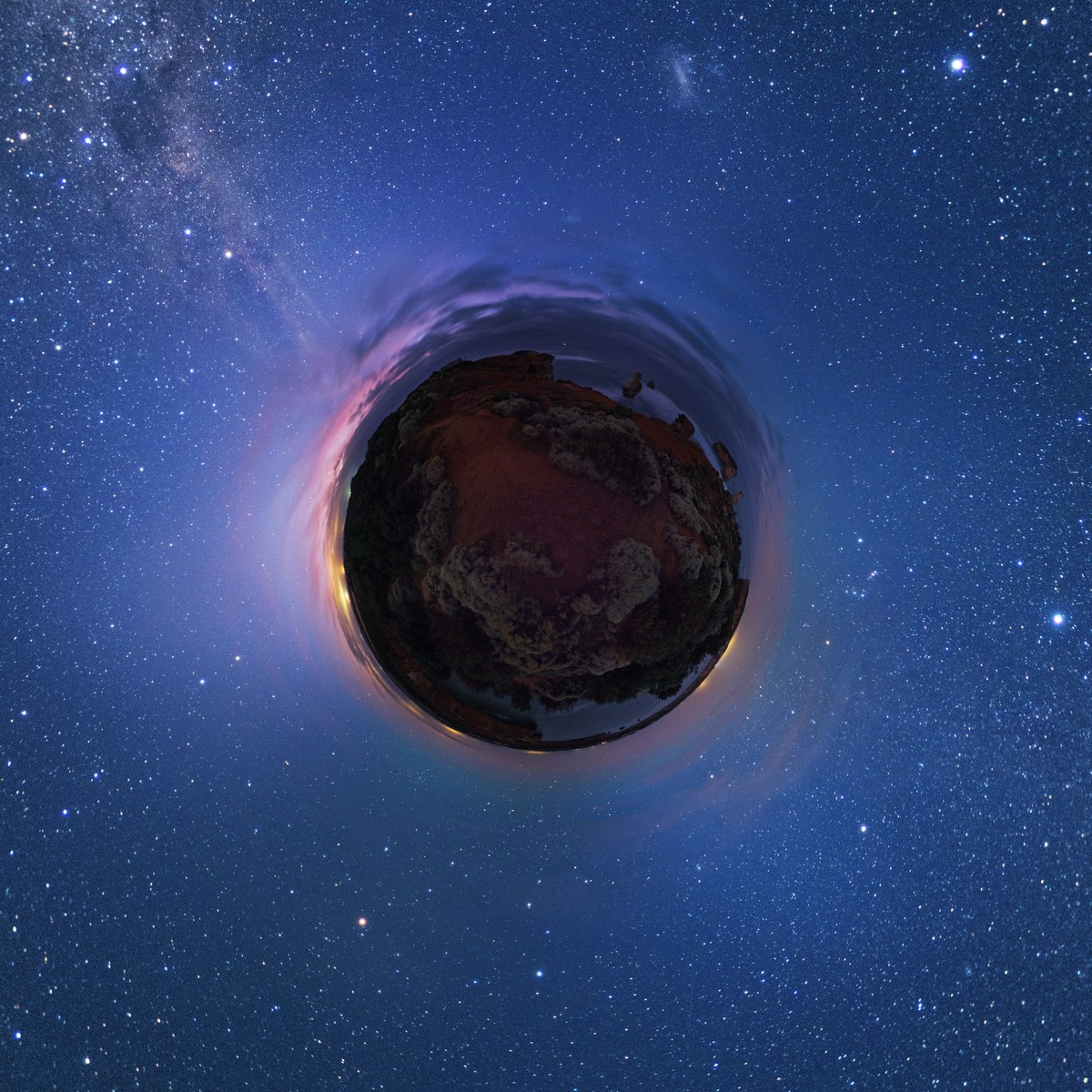 |
| Little Planet Lovejoy (January 11, 2012) |
Also in the picture is the Southern Cross in the top left corner of the frame, and Orion directly to the right of Earth's equator.
Thursday, January 12, 2012
Quarter 2 Astronomer Biography: Nicolas Lacaille

Before this, Lacaille studued rhetoric and philosophy at Collège de Lisieux in France starting in 1729. He was able to attend this school because his father paid, but when Lacaille's father died in 1731, he lost his tuition money. Nicolas Lacaille was able to find a beneficiary, the Duke of Bourbon, to support his studies. After, Lacaille enrolled in a three-year study at the college of Navarre, in order to obtain ordination for priesthood. While studying here, he first encountered mathematics and private studies of astronomy. He graduated in 1736 with a masters and bachelors in Theology, but never obtained ordination for priesthood.
In 1739, Nicolas Lacaille stared working for Jacques Cassini and Jean-Dominique Maraldi at Paris observatory, was involved in the geodesic survey of France. In 1741, however, Lacaille was elected to the Royal Academy of Sciences in Paris, and took his post in the Collège Mazarin where he established an observatory. He began making observations, mainly focusing on Earth's orbit, parallaxes, planetary orbits, comets, and star catalogs. Lacaille also wrote many textbooks on astronomy, mathematics, mechanics, and optics. His books were read many places, had many editions and even were translated to different languages.
While working in Paris, Lacaille became interested in exploring the southern skies and decided to enter an expedition to the Cape of Good Hope. August 6, 1751, Lacaille established an observatory in South Africa and observed the skies for a year. He was able to determine the positions of about 9,800 stars between the celestial south pole and the tropic of Capricorn. Among the stars were 42 nebulous stars, 240 principle stars, and 1,930 stars visible to the naked eye that were extracted for creating a planisphere. He also created 15 constellations, 14 of which are still used today, and took many measurements of the positions of the Moon, the Sun, Venus, and Mars in an effort to obtain parallaxes. Lacaille finally returned home to Paris June 28, 1754.
Nicolas Lacaille made huge advancements in the field of astronomy. The fourteen constellations maned by Lacaille were: Antlia, Caelum, Circinus, Fornax, Horologium, Mensa, Microscopium, Norma, Octans, Pictor, Pyxis, Reticulum, Sculptor, and Telescopium. He was honored for his accomplishments by having a crater on the Moon (La Caille) being named after him in 1961. An asteroid discovered in 1960 was named Asteroid Lacaille in honor of Nicolas.
Friday, January 6, 2012
APOD 2.7
 |
| To Fly Free in Space (January 1, 2012) |
This photograph captures one attention because of the detailed cloud-cover of Earth, contrasted with the completely black space and McCandless. This contrast makes the viewer feel like they could get lost in the picture, as one could get lost in space.
Wednesday, January 4, 2012
Q2 Astronomer Biography Sources
"Lacaille, Nicolas-Louis De." Complete Dictionary of Scientific Biography. Vol. 7. Detroit: Charles Scribner's Sons, 2008. 542-545. Gale Virtual Reference Library. Web. 4 Jan. 2012.
Frommert, Hartmut, and Christine Kronberg. "Nicholas Louis De Lacaille (1713-62)." SEDS Messier Database. Web. 04 Jan. 2012. <http://messier.seds.org/xtra/Bios/lacaille.html>
Lesikar, Arnold V. "Nicolas Louis De Lacaille." The Dome of the Sky. Web. 04 Jan. 2012. <http://domeofthesky.com/clicks/deLacaille.html>
"DOC: Abbe Nicolas Louis De Lacaille." Fortunecity.com. Willmann-Bell, Inc, 3 Dec. 1997. Web. 04 Jan. 2012. <http://www.fortunecity.com/roswell/borley/49/lacaille.htm>.
Subscribe to:
Comments (Atom)