Date: October 25, 2011
Local Time: 9:45 pm
Location: 27.309583 degrees latitude, and -82.503184 degrees longitude
Sarasota, FL 34239
I was able to observe many Magnitude 3 stars, and some Magnitude 4. I was able to identify the Summer Triangle, Cygnus, Cassiopeia, Pleiades, Jupiter, the Square of Pegasus, Perseus, and Draco. Because of a street light, houses, and a couple of large trees, it was difficult to see the southern parts of the sky.
Tuesday, October 25, 2011

Sunday, October 23, 2011
APOD 1.8
 |
| Lightning Eclipse from the Planet of the Goats (June 18, 2011) |
On June 15th there was a lunar eclipse spanning over Europe, Africa, Asia, and Australia, during which occurred a thunderstorm that was passing over Greece. There were lightning strikes that occurred and were captured on a 30 second exposure.
The name comes from the island that it was taken on: the Greek island of Ikaria at Pezi, which translates to "the planet of the goats."
What captivated me about this picture was the harsh, bright lightning bolts juxtaposed with the darker sky where the stars are peeking through the clouds. Nature is a curious thing!
The name comes from the island that it was taken on: the Greek island of Ikaria at Pezi, which translates to "the planet of the goats."
What captivated me about this picture was the harsh, bright lightning bolts juxtaposed with the darker sky where the stars are peeking through the clouds. Nature is a curious thing!
Friday, October 14, 2011
Quarter 1 Astronomer Biography: Joann Bayer
Born in 1572 in Rhain, Bavaria, Germany, Johann Bayer produced the most understandable pre-teloscopic catalog of the stars and established a nomenclature for stars in a constellation that can be seen with the naked eye. His catalog is considered the first atlas of the sky that represented the stars around the South Pole and mapped the whole celestial sphere.
Johann Bayer was not originally an astronomer; he studied law. He moved to Augsburg, Germany to practice law after attending the University at Ingolstadt in 1592. In Augsburg, Bayer worked more on his astronomy interests, and ended up published his catalog, Uranometria, in 1603. Uranometria was a mapping of the sky and a classification system for stars in constellations. Johann Bayer dedicated his book to two leading citizens, and the city counsel of Augsburg, and was appointed the legal advisor to the city.
Bayer was just an amateur astronomer, but the significance of his work was the innovation of his naming system. Bayer wanted to clear up the confusion over the previous naming system by precisely identifying and naming each star in a constellation. Each star was named with a letter from the 24-letter Greek alphabet. If there were more than two dozen stars in the constellation that could be seen with the naked eye, then the Latin alphabet was used also.
Bayer's system did have some flaws: what previous astronomers labeled at the right side of a constellation, he labeled as the left, and he bracketed star within the same constellation that had the same magnitude, but did not indicate how he chose the letters within the brackets. This lead to confusion among astronomers, and there are still objections to some of the theories of how Bayer chose the letters. Bayer's original designations are still in use today, in addition to further designated stars. Because of the advances in technology, more dim stars were able to be located and astronomers have named them with only Roman numerals and the numerals in combination with letters. This lead to additions to Bayer's classification.
Despite the confusion over the structure of the nomenclature of the stars, Johann Bayer aided the division of the celestial sphere. He died in 1625 at the age of 53, Bayer's legacy still lives on. His accomplishments in the field of astronomy were beneficial to the division and organization of the sky, and are still in practice today.
APOD 1.7
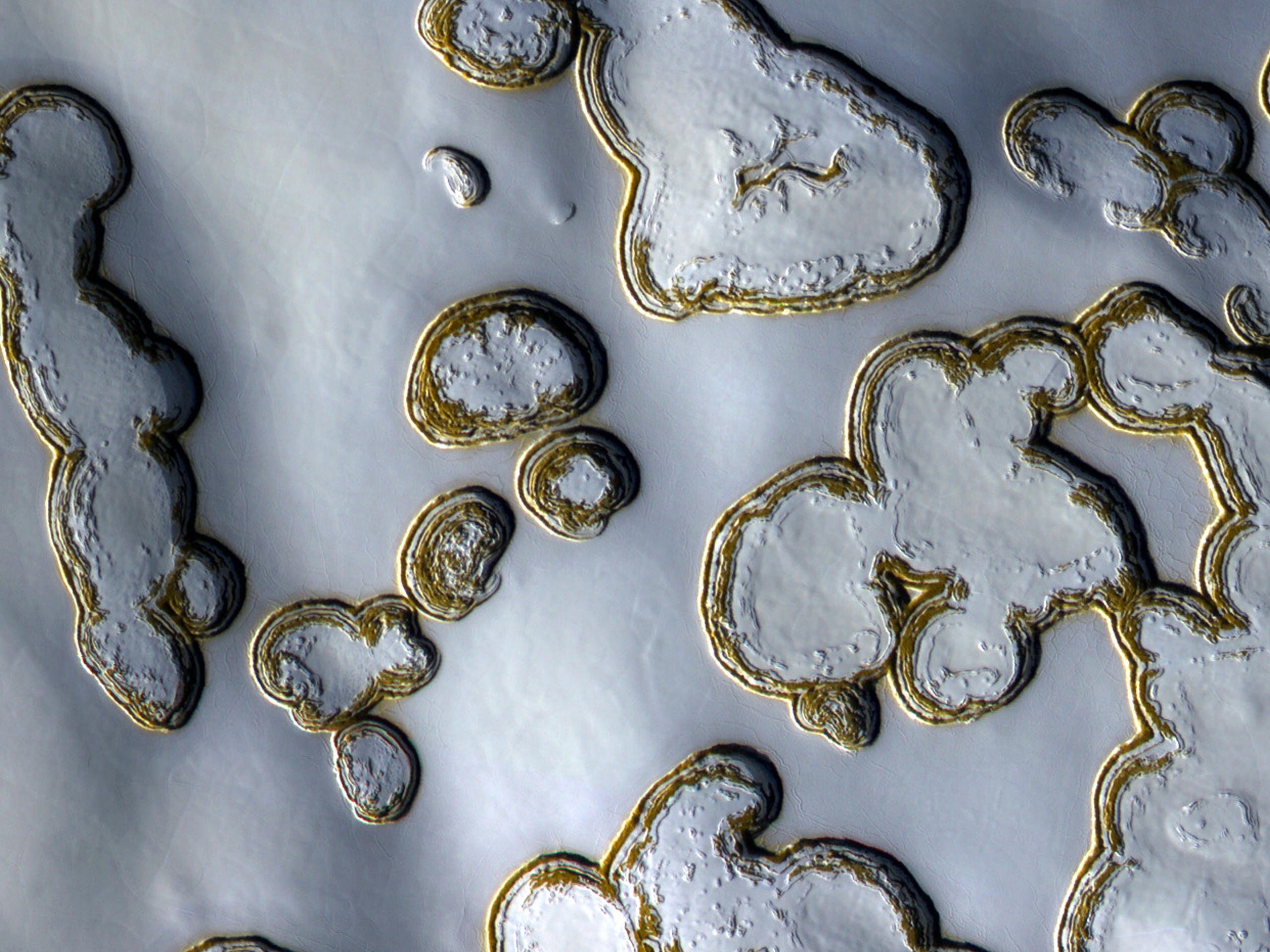 |
| Dry Ice Pits on Mars (September 26, 2011) |
Friday, October 7, 2011
APOD 1.6
 |
| Violent Sunspot Group AR 1302 Unleashes a Flare (September 28, 2011) |
This solar flare is huge! I like that the Earth is in the background too because it gives one perspective on the magnitude of space and the solar system. You can tell that the Earth is far away, and the flare is BIG.
Subscribe to:
Comments (Atom)